A dog runs 20 metres towards the East and turns right. It runs 10 metres and…
2024
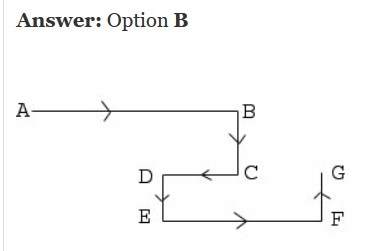
A dog runs 20 metres towards the East and turns right. It runs 10 metres and turns right again. It runs 9 metres and turns left. It runs 5 metres and turns left again. It runs 12 metres and turns left once more, then runs 6 metres. Which direction is the dog now facing?
- A.
East
- B.
North
- C.
West
- D.
South
Attempted by 5 students.
Show answer & explanation
Correct answer: B
Concept: In a direction-sense problem, treat the four compass directions as a repeating clockwise cycle: North, East, South, West, North. A right turn moves the facing direction one step forward in this clockwise cycle (a 90 degree clockwise rotation); a left turn moves it one step backward (a 90 degree anticlockwise rotation). The distances covered on each leg do not affect the final facing direction - only the count and order of turns matter.
Start facing East and run the first leg.
First turn is right: East moves one step clockwise to South.
Second turn is right: South moves one step clockwise to West.
Third turn is left: West moves one step anticlockwise to South.
Fourth turn is left: South moves one step anticlockwise to East.
Fifth turn is left: East moves one step anticlockwise to North.
Cross-check: instead of tracing every leg, add up the net rotation. There are 2 right turns, contributing +90 degrees each (clockwise) for +180 degrees, and 3 left turns, contributing -90 degrees each (anticlockwise) for -270 degrees. The net rotation is 180 minus 270 = -90 degrees, i.e., one step anticlockwise from the starting direction. One anticlockwise step from East lands on North, which matches the leg-by-leg result.
The dog is finally facing North.