Gaurav walks 20 metres towards North. He then turns left and walks 40 metres.…
2026
Gaurav walks 20 metres towards North. He then turns left and walks 40 metres. He again turns left and walks 20 metres. Further, he moves 20 metres after turning to the right. How far is he from his original position?
- A.
40 metres
- B.
50 metres
- C.
60 metres
- D.
20 metres
Attempted by 6 students.
Show answer & explanation
Correct answer: C
Concept: In direction-sense problems, treat each turn as a 90° rotation relative to the compass (a left turn moves North → West → South → East → North; a right turn moves the opposite way), then split the whole path into net North-South and net East-West displacement. Movements along the same axis in opposite directions cancel out, while movements along the same axis in the same direction add up; the final distance from the start is obtained from what remains after this cancellation.
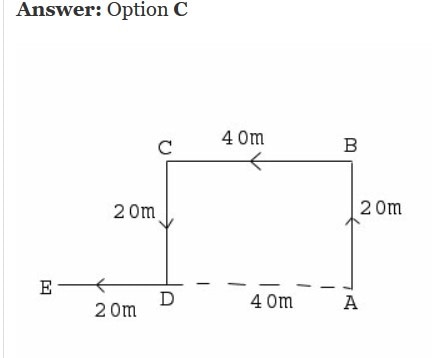
Starting at point A, Gaurav walks 20 m North to reach point B; he is now facing North.
At B he turns left, which changes his facing from North to West, and walks 40 m West to reach point C.
At C he turns left again, changing his facing from West to South, and walks 20 m South to reach point D.
At D he turns right, changing his facing from South to West, and walks 20 m West to reach point E.
Cross-check: The North leg (B) and the South leg (D) are equal in length and opposite in direction, so they cancel out completely — there is no net vertical displacement. The two West legs (B to C, and D to E) run in the same direction, so they add directly to give the net horizontal displacement.
Since the vertical displacement is zero, the straight-line distance from A to E equals this horizontal displacement: 40 m + 20 m = 60 m.