P, Q, R, S, T, U and V are seven persons wearing a kurtas of different colours…
2026
P, Q, R, S, T, U and V are seven persons wearing a kurtas of different colours – pink, red, black, green, yellow, blue and violet – and pajamas of different colours – blue, red, pink, black, cream, yellow and indigo on Diwali festival. The persons, colour of the kurtas and colour of the pajamas above are not necessarily in the same order. None of the person is wearing kurta and pajamas of same colour.Q is wearing red kurta and is not wearing cream or yellow pajamas. S is wearing green kurta and indigo pajamas. Colour of P’s kurta and U’ pajama is same. Colour of T’s kurta and R’s pajamas is same. V is wearing blue kurta and T is wearing blue pajamas. U is not wearing any yellow dress. Red and blue is not the combination of kurta and pajamas of any of the persons.What is the colour of Q’s pajamas?
- A.
red
- B.
green
- C.
yellow
- D.
black/ pink
Attempted by 7 students.
Show answer & explanation
Correct answer: D
In a data-arrangement (matrix) puzzle, each person is assigned exactly one value from every attribute list, and every stated clue — a direct assignment, an equality between two people's attributes, or an exclusion — eliminates certain values from a person's remaining possibilities. Work outward from the direct clues, then propagate the equality and exclusion clues until only valid combinations remain; when the surviving clues leave a genuine tie between colours for a person, the fully correct answer must record every surviving possibility.
Place the direct clues: S has green kurta and indigo pajama; V has blue kurta; T has blue pajama.
From "no person's kurta and pajama share a colour," Q (red kurta) cannot have a red pajama; combined with "Q's pajama is not cream or yellow," Q's pajama must be pink or black.
T's kurta must equal R's pajama; because violet is not among the seven pajama colours, T's kurta cannot be violet, so T's kurta is pink, black, or yellow.
If T's kurta were pink or black, P (who must share a colour with U's pajama, and can only do so through pink or black) and T would use up both pink and black between them, pushing R to yellow-kurta and U to violet-kurta; U's pajama would then equal P's kurta and R's pajama would equal T's kurta, consuming both pink and black and leaving no legal pink/black pajama for Q — a contradiction. So T's kurta must be yellow, and therefore R's pajama is yellow.
U cannot wear any yellow item, so U's kurta and pajama are both non-yellow; with T fixed at yellow-kurta, the three colours pink, black, violet remain for P, R and U's kurtas.
Since violet is not a valid pajama colour, U's pajama (which must equal P's kurta) cannot be violet — so P's kurta, and hence U's pajama, is pink or black. R and U then freely split the remaining two of pink, black, violet between their kurtas — either way is consistent, since neither collides with a fixed pajama colour, so this leaves a further genuine tie for R's and U's kurtas that does not affect Q's pajama.
Whichever of pink or black U's pajama takes, Q's pajama (also restricted to pink or black) must take the other one, since the two people cannot share a colour — so it is internally consistent whether U's pajama is pink (Q's pajama then black) or U's pajama is black (Q's pajama then pink).
On the remaining pajama colours, V's kurta is blue, and the red-kurta/blue-pajama combination is banned for every person, so V's pajama cannot be red; with pink, black, yellow and indigo already placed, V's pajama must be cream, leaving red as the only colour left for P's pajama.
Checking the arrangement against every clue — matching kurta/pajama pairs never repeat a colour for the same person, Q avoids cream and yellow, S is green/indigo, P's kurta matches U's pajama, T's kurta matches R's pajama, V is blue-kurta with T blue-pajama, U avoids yellow entirely, and no one pairs red with blue — confirms every combination of the tied values below is valid, and in every one of them, Q's pajama is exactly the colour not taken by U's pajama.
The fully solved arrangement is summarised below, with a slash separating tied values that satisfy every clue equally:
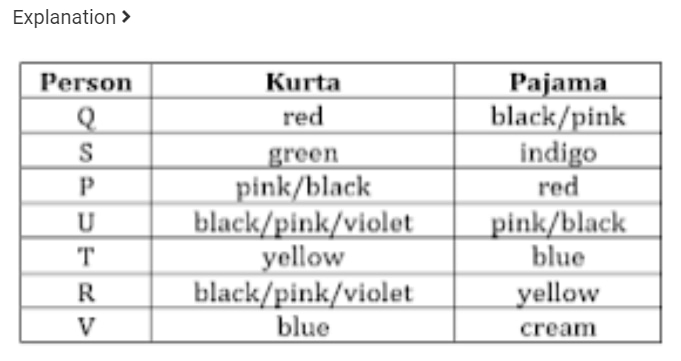
Therefore, Q's pajama colour is black or pink.