P, Q, R, S, T, U and V are seven persons wearing kurtas of different colours –…
2025
P, Q, R, S, T, U and V are seven persons wearing kurtas of different colours – pink, red, black, green, yellow, blue and violet – and pajamas of different colours – blue, red, pink, black, cream, yellow and indigo – on Diwali. The persons and the colours of the kurtas and pajamas above are not necessarily in the same order. None of the persons is wearing a kurta and pajama of the same colour. Q is wearing a red kurta and is not wearing a cream or yellow pajama. S is wearing a green kurta and indigo pajama. The colour of P’s kurta and U’s pajama is the same. The colour of T’s kurta and R’s pajama is the same. V is wearing a blue kurta and T is wearing a blue pajama. U is not wearing anything yellow. Red and blue is not the kurta-pajama combination for any of the persons. What is the colour of Q’s pajama?
- A.
red
- B.
green
- C.
yellow
- D.
black/ pink
Attempted by 3 students.
Show answer & explanation
Correct answer: D
This is a linear/grid deduction puzzle: fix every value stated directly by the clues in a person × attribute (kurta, pajama) grid, then use each ‘X’s kurta colour = Y’s pajama colour’ clue as a bridge linking the two attribute columns, and eliminate remaining candidates using two universal rules — no person repeats colour across kurta and pajama, and no colour is reused by two different persons.
Enter the direct clues: kurta(Q) = red; kurta(S) = green and pajama(S) = indigo; kurta(V) = blue; pajama(T) = blue.
Apply ‘no person wears the same colour kurta and pajama’ plus ‘red and blue is never a kurta-pajama pair for one person’: since kurta(V) = blue, pajama(V) cannot be blue or red, so it must come from pink, black, cream or yellow.
Use the two bridging clues — kurta(P) = pajama(U), and kurta(T) = pajama(R). Q’s pajama is already barred from cream and yellow (given), from red (same-colour rule, since kurta(Q) = red) and from blue (red-blue rule), leaving only pink or black for Q’s pajama — and, because U is under the identical set of leftover pajama colours, pajama(U) is also confined to pink or black; since kurta(P) = pajama(U), kurta(P) is confined to pink or black too.
The four remaining kurta colours — pink, black, yellow, violet — split across P, R, T, U. U cannot wear anything yellow, and P is already confined to pink or black, so yellow can only sit with T or R; placing it on R would force pajama(R) (equal to kurta(T)) into a colour already taken elsewhere in the same pool, so yellow settles on T: kurta(T) = yellow, which fixes pajama(R) = yellow.
Violet — the one kurta colour left unused by Q, S, V and T — cannot go to P (confined to pink or black), so it must belong to R or U; the colour this leaves open for V’s pajama is cream, completing V’s row (pajama(V) = cream).
What remains is exactly one free swap: pink and black can trade places between Q’s pajama and U’s pajama (with the matching trade between P, R, U’s kurta) without breaking a single stated rule either way — the puzzle’s own clues never force one order over the other.
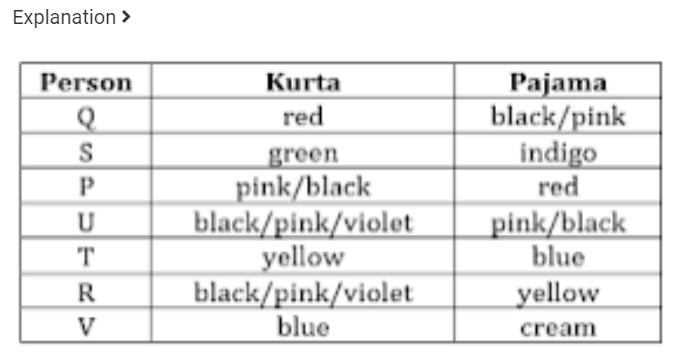
The completed grid below satisfies every clue with no violations: no person repeats a colour across kurta and pajama, no colour is reused between persons in either branch, and the red-blue pair never occurs together.
Person | Kurta | Pajama |
|---|---|---|
Q | red | black / pink |
S | green | indigo |
V | blue | cream |
T | yellow | blue |
R | pink / black / violet | yellow |
P | pink / black | red |
U | pink / black / violet | pink / black |
So Q’s pajama colour is not pinned to a single value by the clues — it is genuinely black or pink, which is exactly what the answer option ‘black/ pink’ represents.