In a certain society, there are two marriage groups, Red and Brown. No…
2026
In a certain society, there are two marriage groups, Red and Brown. No marriage is permitted within a group. On marriage, males become part of their wife's group; women remain in their own group. Children belong to the same group as their parents. Widowers and divorced males revert to the group of their birth. Marriage to more than one person at the same time and marriage to a direct descendant are forbidden. A Brown female could have had: i. a grandfather born Brown ii. a grandfather born Red iii. two grandfathers born Brown (Questions 1 to 3 are linked together)
- A.
I only
- B.
III only
- C.
I and II only
- D.
II and III only
Attempted by 4 students.
Show answer & explanation
Correct answer: C
Concept: In this exogamous group-marriage system, a woman keeps her birth group for life, while a man keeps his birth group only until he marries; on marriage he takes his wife's group (and only reverts to his birth group if later widowed or divorced). A child's group is the group its parents share at the child's birth. So whenever a person's group differs from one parent's own birth group, that parent must have married in from the OTHER group — and the very same rule then applies one generation further back to that parent's own parents.
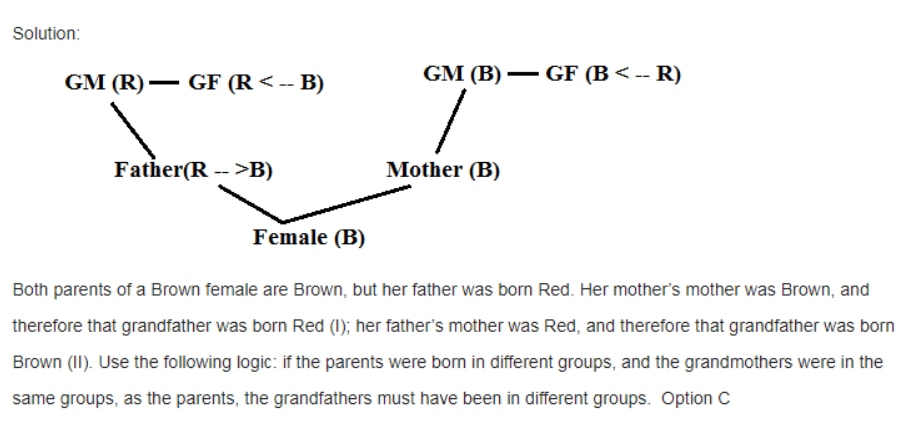
The Brown female (call her F) is Brown by birth, so at her birth her parents were a Brown family unit: her mother is Brown-born (women never change group), and her father — since no one may marry within their own group — must have married INTO the Brown group, meaning he was born Red.
Apply the same rule one generation back through F's mother (Brown-born): her parents were a Brown family unit too — her mother (F's maternal grandmother) Brown-born, and her father married into Brown, so he was born Red. This fixes F's maternal grandfather as born Red.
Apply the same rule one generation back through F's father (born Red): his parents were a Red family unit — his mother (F's paternal grandmother) Red-born, and his father married into Red, so he was born Brown. This fixes F's paternal grandfather as born Brown.
So F's ancestry FIXES both grandfathers to different birth-colors: paternal grandfather born Brown, maternal grandfather born Red — these are certainties, not mere possibilities.
Cross-check: Because the two grandfathers are forced to opposite birth-colors, F can never have two grandfathers born the same color — the "two grandfathers born Brown" case is ruled out entirely, while "a grandfather born Brown" and "a grandfather born Red" are both guaranteed to hold at once.
“I only” leaves out the equally guaranteed second grandfather fact — both statements hold together, not just one of them.
“III only” claims two grandfathers born Brown, which the rule rules out — F's two grandfathers are always fixed to opposite colors, never the same one.
“II and III only” correctly keeps the guaranteed Red-born grandfather but wrongly re-adds the impossible “two Brown grandfathers” claim in place of the other guaranteed fact.