Direction: These questions are based on the following information. There are 7…
2024
Direction: These questions are based on the following information. There are 7 members present – A, B, C, D, E, F, and G in a family of three generations in which three are married couples. C is the spouse of F. D is the daughter of B. E has only one daughter. C is the son of A. E is the brother-in-law of G. B is the spouse of E. C is the grandson of E. Who is the mother-in-law of A?
- A.
E
- B.
D
- C.
G
- D.
B
Attempted by 12 students.
Show answer & explanation
Correct answer: D
Concept: A person's mother-in-law is the mother of that person's spouse — not the person's own mother. To find X's mother-in-law, first pin down X's spouse from the family clues, then find that spouse's mother. Relational terms such as 'son of', 'daughter of', 'grandson of', 'spouse of', and 'brother-in-law of' must all be chained together into one consistent family tree before the question can be answered.
Application: Chaining the clues step by step:
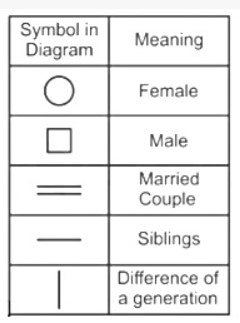
B is the spouse of E, so B and E form a married couple in the eldest (first) generation of the family.
D is the daughter of B, so D is a child of the B–E couple, in the second generation.
E has only one daughter. Since D is a daughter of B (and hence of E), D must be that one daughter — B and E have no other daughter.
C is the spouse of F, so C and F form a second married couple.
E is the brother-in-law of G. This is a same-generation, marriage-linked relationship at E's own (eldest) generation — it does not make G anyone's parent-in-law or child-in-law.
C is the grandson of E and also the son of A, so A must belong to the same generation as B and E's own children — either as their child, or as the spouse of one of their children. A cannot be a second daughter of B and E, since D is their only daughter (step 3). A also cannot be a son of B and E: that would require A's spouse (needed to have son C) to be one of the two remaining members, F or G — but F is already C's spouse (step 4), and if G were A's spouse, E would be G's father-in-law rather than G's brother-in-law, contradicting step 5. So the only reading consistent with every clue is that A married into the family as D's spouse.
With A married to D, and D being the daughter of B, B is the mother of A's spouse — by the concept above, that makes B the mother-in-law of A. This also places F correctly as the daughter-in-law of A and D (the wife of their son C), and accounts for G as the seventh family member through E's brother-in-law relation, without needing a fourth married couple.
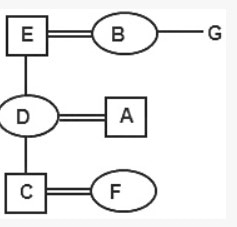
Cross-check: This assignment uses exactly three married couples — B–E, A–D, and C–F — matching the seven members and three generations stated in the question, and every clue is satisfied consistently (C's grandparent-hood through E and D, D being E's only daughter, and E's brother-in-law link to G). No alternative assignment of A's family position keeps all seven clues consistent, confirming the relationship found above.
Result: B is the mother-in-law of A.