Find the number of triangles in the given figure.
20242023
Find the number of triangles in the given figure.
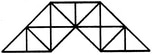
- A.
23
- B.
27
- C.
29
- D.
31
Attempted by 8 students.
Show answer & explanation
Correct answer: C
Concept: To count all the triangles in a composite figure, classify every triangle by how many of the smallest, irreducible triangular regions it is built from. Count every 1-region (simplest) triangle, then every additional triangle formed by joining 2 adjoining regions into a larger triangle, then every triangle formed by joining 4 adjoining regions, and so on. The total number of triangles in the figure is the sum of the counts across all these levels.
Application: Label the figure as shown below, then count triangles level by level.
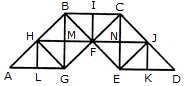
Simplest (1-region) triangles: AHL, LHG, GHM, HMB, GMF, BMF, BIF, CIF, FNC, CNJ, FNE, NEJ, EKJ and JKD — 14 triangles.
Triangles formed of two adjoining regions each: AGH, BHG, HBF, BFG, HFG, BCF, CJF, CJE, JEF, CFE and JED — 11 triangles.
Triangles formed of four adjoining regions each: ABG, CBG, BCE and CED — 4 triangles.
Sum every level: 14 + 11 + 4 = 29.
Cross-check: The figure's own outer boundary is not itself a single triangle — it is a wider trapezoid-shaped truss with two peaks — so there is no additional whole-figure triangle to add beyond the 1-region, 2-region and 4-region groups already counted. This confirms the count correctly stops at these three levels, with nothing missed and nothing double-counted.
Hence, the total number of triangles in the given figure is 29.