In a 200 meters race , A beats B by 15 meters , while in a 100 meters race , B…
2026
In a 200 meters race , A beats B by 15 meters , while in a 100 meters race , B beats C by 8 meters . A beats C in a kilometer race by
- A.
198 meters
- B.
241 meters
- C.
149 meters
- D.
80 meters
Attempted by 5 students.
Show answer & explanation
Correct answer: C
Concept: When two runners are compared only through a common third runner (they never race each other directly), first convert each race's 'beats by' statement into a speed ratio for that race, then chain the two ratios together by matching the common runner's value in both, so the ratio between the two runners who never raced directly can be read off.
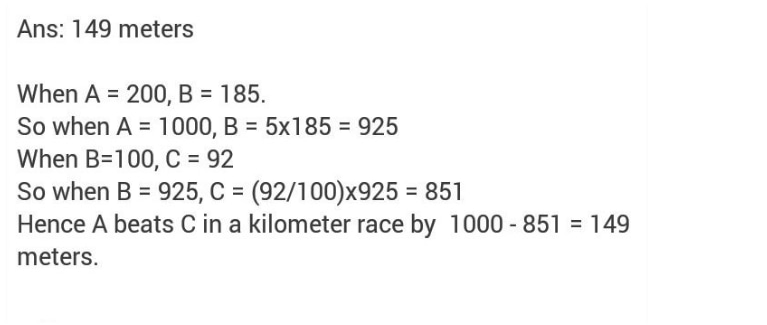
In the 200 m race, A beats B by 15 m, so when A covers 200 m, B covers 200 − 15 = 185 m. This gives the speed ratio A : B = 200 : 185 = 40 : 37.
In the 100 m race, B beats C by 8 m, so when B covers 100 m, C covers 100 − 8 = 92 m. This gives the speed ratio B : C = 100 : 92 = 25 : 23.
To chain the two ratios, match B's value in both: A : B has B = 37 and B : C has B = 25; since these share no common factor, their LCM is 37 × 25 = 925. Scale A : B = 40 : 37 by 25 to get 1000 : 925, and scale B : C = 25 : 23 by 37 to get 925 : 851. So A : B : C = 1000 : 925 : 851.
So when A completes the kilometre (1000 m) race, C covers 851 m. The margin by which A beats C is 1000 − 851 = 149 m.
Cross-check: From A : B = 1000 : 925, when A runs 1000 m, B runs 925 m, and 925/1000 = 0.925 matches the original 185/200. From B : C = 925 : 851, when B runs 925 m, C runs 851 m, and 851/925 = 0.92 matches the original 92/100. Both original ratios check out, confirming C covers 851 m when A covers 1000 m.
Answer: A beats C by 149 m in the kilometre race.