Two cyclists A and B cover a distance of 110 km. A reaches the destination one…
2026
Two cyclists A and B cover a distance of 110 km. A reaches the destination one hour before B. Even if B is given a head start of 8 km, he would still reach 12 minutes late. Find the speed of A (in km/h).
- A.
10
- B.
11
- C.
12
- D.
15
Attempted by 4 students.
Show answer & explanation
Correct answer: B
Concept: For a fixed route, time taken equals distance divided by speed. When the slower traveller is given a head start (the distance they must cover is reduced), the resulting change in how late they arrive isolates that traveller's own speed, because only their distance changed while the faster traveller's time stayed fixed.
Setup: Let the speed of cyclist A be a km/h and the speed of cyclist B be b km/h.
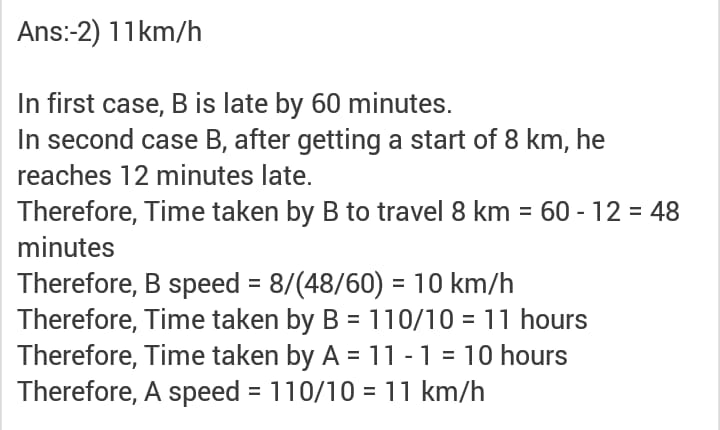
Time taken by A to cover 110 km = 110/a hours. Time taken by B to cover 110 km = 110/b hours. Since B arrives 1 hour (60 minutes) after A: 110/b - 110/a = 1.
With an 8 km head start, B only has to cover 110 - 8 = 102 km, and still arrives 12 minutes after A's (unchanged) arrival time: 102/b - 110/a = 12/60 = 0.2 hours.
Subtracting the second equation from the first eliminates the 110/a term: (110/b - 102/b) = (1 - 0.2), so 8/b = 0.8, giving b = 10 km/h.
Substituting b = 10 back into the first equation: 110/10 - 110/a = 1, so 11 - 110/a = 1, so 110/a = 10, so a = 11 km/h.
Cross-check: At 11 km/h, A covers 110 km in 10 hours. At 10 km/h, B covers the full 110 km in 11 hours - exactly 1 hour after A, matching the first condition. With the 8 km head start, B covers 102 km at 10 km/h in 10.2 hours (10 hours 12 minutes) - exactly 12 minutes after A's 10-hour arrival, matching the second condition.
Answer: Therefore, the speed of cyclist A is 11 km/h.