Anusha, Banu and Esha run a 100-meter race. Anusha is the fastest, followed by…
2024
Anusha, Banu and Esha run a 100-meter race. Anusha is the fastest, followed by Banu and then Esha. Anusha, Banu and Esha maintain constant speeds throughout the race. When Anusha reached the goal post, Banu was 10 m behind. When Banu reached the goal post, Esha was 10 m behind. How much distance did Esha cover when Anusha reached the goal post?
- A.
70 m
- B.
81 m
- C.
90 m
- D.
80 m
Attempted by 11 students.
Show answer & explanation
Correct answer: B
Concept: When several runners maintain constant speeds throughout a race, the distances any two of them cover in the same elapsed time are always in the fixed ratio of their speeds. If runner X finishes a distance d while runner Y, moving at a constant lesser speed, covers only d′ in that same time, then Speed(X) : Speed(Y) = d : d′. This ratio can be chained across multiple pairs of runners to relate the distances covered by runners who are never directly compared to each other.
Applying this to the problem:
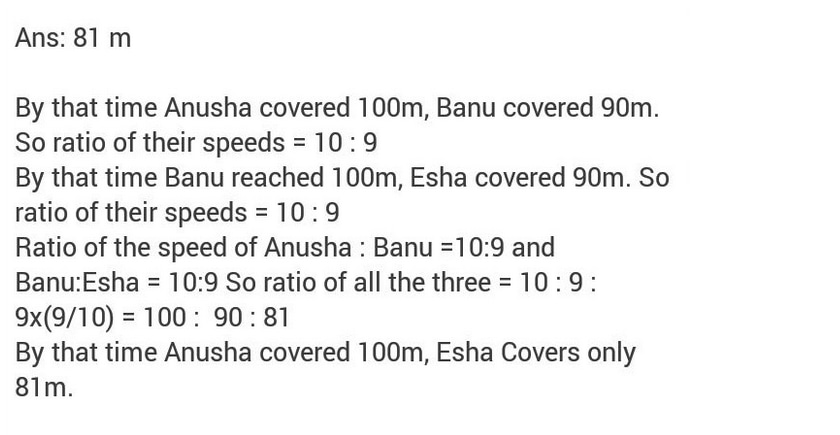
Anusha finishes the 100 m race while Banu, running at a constant speed, has covered only 90 m (100 − 10) in that same time. So Speed(Anusha) : Speed(Banu) = 100 : 90 = 10 : 9.
Banu finishes 100 m while Esha, at her constant speed, has covered only 90 m (100 − 10) in that same time. So Speed(Banu) : Speed(Esha) = 100 : 90 = 10 : 9.
Multiply the two ratios to connect Anusha and Esha directly: Speed(Anusha) : Speed(Esha) = (10/9) × (10/9) = 100 : 81.
Since all three runners move at constant speeds, distances covered in the same time are in the same ratio as their speeds. So when Anusha covers 100 m, Esha covers 81 m.
Cross-check: using Banu as the middle runner — in the time Anusha covers 100 m, Banu covers 90 m (given directly). In that same time, Esha covers 9/10 of what Banu covers (from Banu:Esha = 10:9), i.e. 90 × 9/10 = 81 m — the same value, confirming the answer.
So Esha has covered 81 m when Anusha reaches the goal post.