A person planning a weekend picnic trip should not spend more than 8 hours…
2025
A person planning a weekend picnic trip should not spend more than 8 hours driving in total for the round trip (going and returning on the same day). The average speed of the forward journey is 40 km/hr. Due to traffic on the return (a Sunday), the average speed of the return journey is 30 km/hr. How far can he select a picnic spot?
- A.
120 km
- B.
150 km
- C.
160 km
- D.
Between 130 and 140 km
Attempted by 261 students.
Show answer & explanation
Correct answer: D
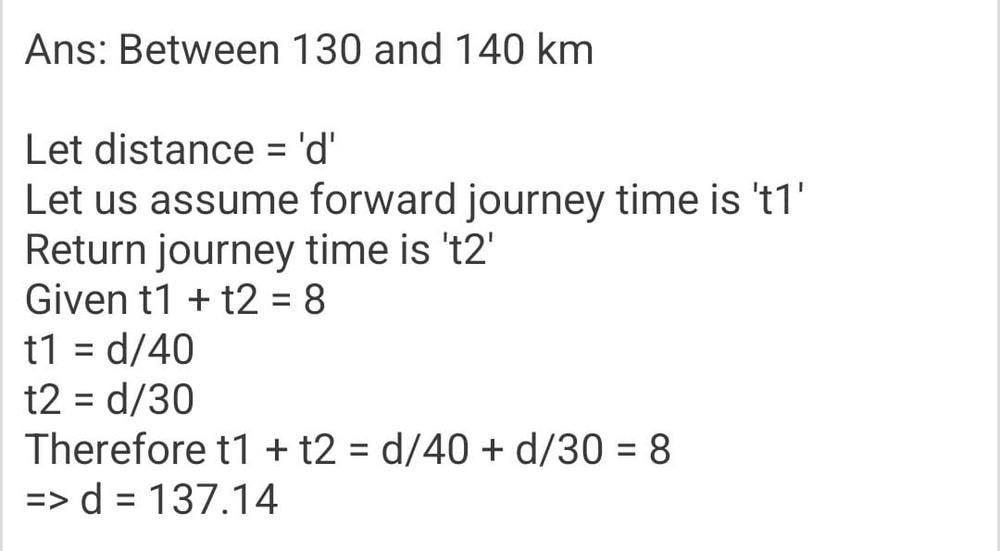
Concept: For a two-leg trip covered at different speeds over the same one-way distance d, the total time is time forward + time return = d/speed(forward) + d/speed(return), and this total strictly increases as d increases. So when a cap says the time must "not exceed" a limit T, the maximum distance is reached exactly at the boundary — the largest d for which the total time equals T, since equality is still allowed.
Applying it here:
Let the one-way distance to the picnic spot be d km.
Forward average speed = 40 km/h, so forward time = d/40 hours.
Return average speed = 30 km/h (slower due to Sunday traffic), so return time = d/30 hours.
The trip must not exceed 8 hours total, so the maximum d satisfies d/40 + d/30 = 8.
Combine the fractions over a common denominator of 120: 3d/120 + 4d/120 = 7d/120 = 8.
Solve for d: d = 8 × 120 / 7 = 960/7 ≈ 137.14 km.
Cross-check: At d ≈ 137.14 km, forward time = 137.14/40 ≈ 3.43 h and return time = 137.14/30 ≈ 4.57 h, summing to ≈ 8.00 h — exactly the cap, confirming the boundary case.
Result: The maximum one-way distance is ≈137.14 km, which falls inside the 130–140 km bracket — not because any distance up to 140 km is allowed, but because the single computed value 137.14 km lands in that range.