4, 4, 12, 16, 36, 36, 108, ?
2026
4, 4, 12, 16, 36, 36, 108, ?
- A.
66
- B.
64
- C.
82
- D.
86
Attempted by 4 students.
Show answer & explanation
Correct answer: B
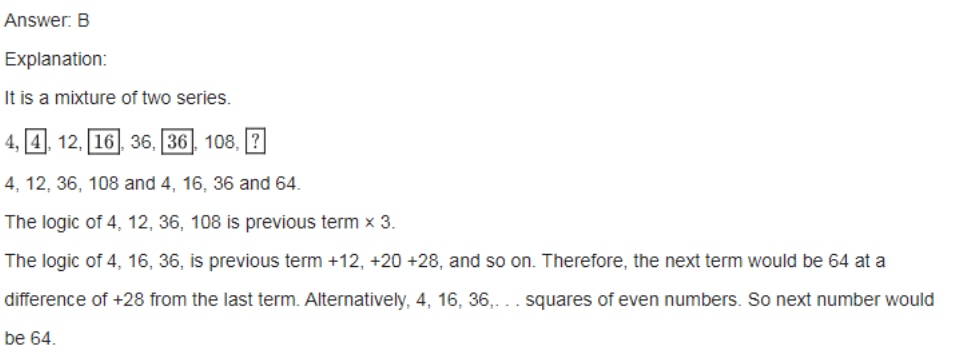
CONCEPT: When a numeric series does not fit one single simple progression, check whether it is actually two INTERLEAVED sub-series occupying alternate positions (1st, 3rd, 5th, 7th... and 2nd, 4th, 6th, 8th...), each following its own independent rule (arithmetic, geometric, or a squares-based pattern).
APPLICATION
Separate the given terms 4, 4, 12, 16, 36, 36, 108, ? by position: the odd-position terms are 4, 12, 36, 108 and the even-position terms are 4, 16, 36, ? (the missing term).
Odd-position sub-series: 12 / 4 = 3, 36 / 12 = 3, 108 / 36 = 3, so each term is the previous term multiplied by 3 (a geometric progression with common ratio 3).
Even-position sub-series: the differences between consecutive terms are 16 - 4 = 12 and 36 - 16 = 20; the difference itself increases by 8 each time (12, then 20, then 28), so the next term is 36 + 28 = 64.
Equivalently, 4, 16, 36 are the squares of consecutive even numbers (22, 42, 62), so the next term is 82 = 64.
CROSS-CHECK: Both routes to the even-position sub-series - the growing-difference pattern (+12, +20, +28) and the squares-of-even-numbers pattern - independently give the same value, 64, confirming the missing term.