8, 9, 11, 15, 23, 39, ?
2026
8, 9, 11, 15, 23, 39, ?
- A.
65
- B.
70
- C.
71
- D.
74
Attempted by 9 students.
Show answer & explanation
Correct answer: C
In a number series where the terms themselves do not follow a constant difference or ratio, check the pattern formed by the DIFFERENCES between consecutive terms instead. If those differences form a recognisable pattern (for example, successive powers of a number), the next term of the series is found by extending that difference pattern and adding the result to the last given term.
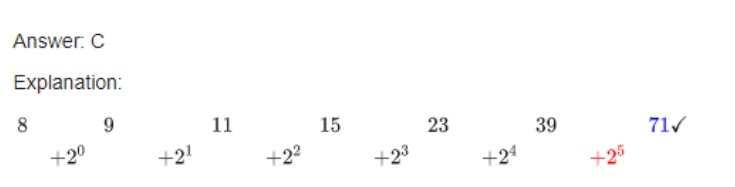
Find the difference between each pair of consecutive terms: 9 - 8 = 1, 11 - 9 = 2, 15 - 11 = 4, 23 - 15 = 8, 39 - 23 = 16.
These differences are 1, 2, 4, 8, 16 - each one is exactly double the one before it, i.e. successive powers of 2 (20, 21, 22, 23, 24).
The next difference in this doubling pattern is 25 = 32.
Add this difference to the last given term: 39 + 32 = 71.
As an independent check, add up all six differences from the start (1 + 2 + 4 + 8 + 16 + 32 = 63) and add that running total to the very first term: 8 + 63 = 71 - the same result, confirming the pattern holds consistently across the whole series.