In a potato race, 20 potatoes are placed in a line at intervals of 4 meters,…
2026
In a potato race, 20 potatoes are placed in a line at intervals of 4 meters, with the first potato 24 meters from the starting point. A contestant is required to bring the potatoes back to the starting point one at a time. How far would he run in bringing back all the potatoes?
- A.
2480 m
- B.
1440 m
- C.
2400 m
- D.
1240 m
Attempted by 7 students.
Show answer & explanation
Correct answer: A
For a task where an item is fetched and carried back to the start one at a time, the total distance run forms an arithmetic progression (AP): each round trip's distance is twice the item's distance from the start, and consecutive round trips increase by a constant amount equal to twice the gap between consecutive items. For n such round trips, the total distance is the sum of an AP: Sn = n/2 [2a + (n − 1)d], where a is the first term and d is the common difference.
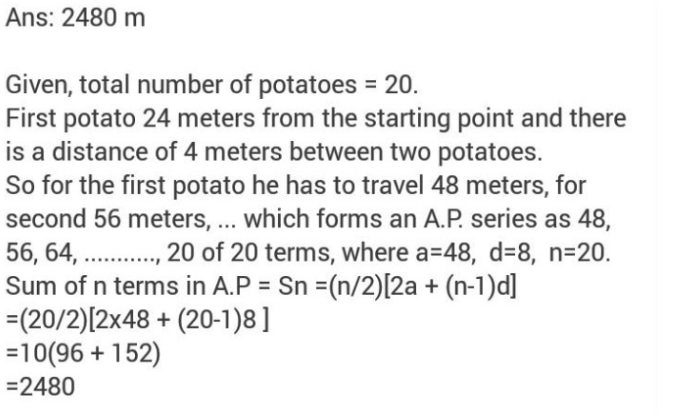
Applying this to the potato race:
The 1st potato is 24 m from the start, so its round trip covers 2 × 24 = 48 m. This is the first term: a = 48 m.
Consecutive potatoes are 4 m apart, so consecutive round trips differ by 2 × 4 = 8 m. This is the common difference: d = 8 m.
There are n = 20 potatoes, so the total distance is the sum of 20 terms: S20 = 20/2 [2(48) + (20 − 1)(8)].
S20 = 10 [96 + 152] = 10 × 248 = 2480 m.
Cross-check using the average-of-first-and-last-term method: the 20th potato's round trip is 48 + 19 × 8 = 200 m. The average of the first and last round trips is (48 + 200)/2 = 124 m, and over 20 trips this gives 20 × 124 = 2480 m — matching the AP sum, confirming the total distance is 2480 m.