If A represents the arithmetic mean, H represents the harmonic mean and G…
2026
If A represents the arithmetic mean, H represents the harmonic mean and G represents the geometric mean of two positive numbers, then what is the relation between them ?
- A.
A x H = G
- B.
A x H = G2
- C.
A / H = G2
- D.
A / H = G
Attempted by 2 students.
Show answer & explanation
Correct answer: B
Concept: For two positive numbers a and b, the arithmetic mean is A = (a + b)/2, the geometric mean is G = sqrt(ab), and the harmonic mean is H = 2ab/(a + b). These three means always satisfy a fixed identity - the product of the arithmetic mean and the harmonic mean equals the square of the geometric mean - for any positive a and b.
Substitute the definitions into the product: A x H = [(a + b)/2] x [2ab/(a + b)].
The factor (a + b) cancels between the numerator and the denominator, leaving A x H = ab.
Since G = sqrt(ab), squaring both sides gives G2 = ab.
Both expressions equal ab, so A x H = G2.
Cross-check: for a = 2 and b = 8, A = 5, G = sqrt(16) = 4, and H = 2 x 2 x 8 / 10 = 3.2. Then A x H = 5 x 3.2 = 16, and G2 = 42 = 16 - the two sides agree, confirming the identity.
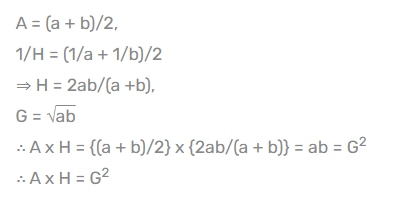
Result: the relation that multiplies A and H and squares G, A x H = G2, holds in general; forms that divide A by H, or that leave G unsquared, do not satisfy this identity.