The shopkeeper charged 12 rupees for a bunch of chocolate but I bargained to…
2025
The shopkeeper charged 12 rupees for a bunch of chocolate but I bargained to shopkeeper and got two extra ones and that made them cost one rupee for dozen less then first asking price. How many chocolates I received in 12 rupees after bargaining?
- A.
12
- B.
16
- C.
18
- D.
14
Attempted by 11 students.
Show answer & explanation
Correct answer: C
Concept: When a fixed amount of money (here, Rs 12) buys a changing number of identical items, the price per dozen scales as (total money ÷ quantity) × 12. A stated change in this per-dozen price between two purchase scenarios sets up an equation relating the two quantities, which solves as a quadratic.
Application: Set up the two price-per-dozen expressions and equate their difference to the stated Rs 1 drop.
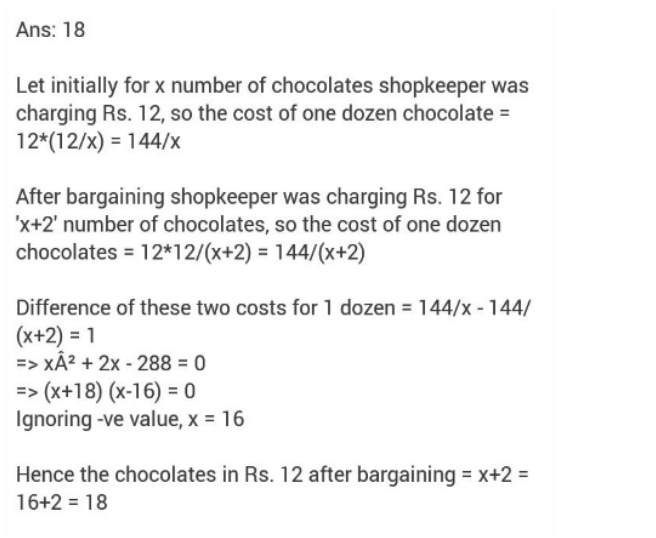
Let the number of chocolates bought for Rs 12 before bargaining be x.
Price per dozen at this rate = (12/x) × 12 = 144/x rupees.
After bargaining, the same Rs 12 buys x + 2 chocolates, so the new price per dozen = 144/(x+2) rupees.
The new price per dozen is Rs 1 less than the old one: 144/x − 144/(x+2) = 1.
Multiplying through by x(x+2): 144(x+2) − 144x = x(x+2), which simplifies to x² + 2x − 288 = 0.
Solving the quadratic: x = [−2 ± √(4 + 1152)] / 2 = [−2 ± 34] / 2, so x = 16 (rejecting the negative root).
The question asks for the quantity received after bargaining, which is x + 2 = 18.
Cross-check: Before bargaining, 16 chocolates cost Rs 12, i.e., Rs 144/16 = Rs 9 per dozen; after bargaining, 18 chocolates cost Rs 12, i.e., Rs 144/18 = Rs 8 per dozen. The drop of Rs 9 − Rs 8 = Rs 1 matches the given condition, confirming the answer.