There are 500 students in an examination. 150 students passed the first paper,…
2025
There are 500 students in an examination. 150 students passed the first paper, 350 students passed the second paper and 50 students passed both the papers. Find the probability that a student selected at random has failed in both the papers.
- A.
1/5
- B.
1/10
- C.
3/10
- D.
3/5
Attempted by 2 students.
Show answer & explanation
Correct answer: B
Concept: For two events A and B in a sample space, the inclusion–exclusion principle gives the count of outcomes in their union as n(A ∪ B) = n(A) + n(B) − n(A ∩ B). The number of outcomes outside this union (in neither A nor B) is the complement: n(Total) − n(A ∪ B), and dividing by the total gives the corresponding probability.
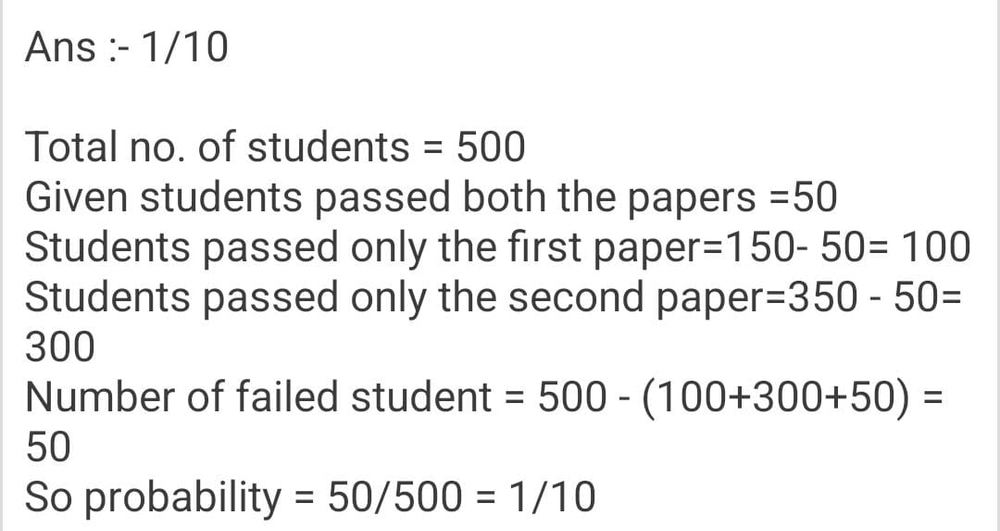
Let A = set of students who passed the first paper and B = set of students who passed the second paper. Given: n(A) = 150, n(B) = 350, n(A ∩ B) = 50 (passed both), and total students = 500.
Number of students who passed at least one paper: n(A ∪ B) = n(A) + n(B) − n(A ∩ B) = 150 + 350 − 50 = 450.
Students who failed both papers are exactly those outside A ∪ B: 500 − 450 = 50.
Probability that a randomly selected student failed both papers = 50 / 500 = 1/10.
Cross-check: Splitting the 450 students who passed at least one paper into disjoint groups confirms the count: passed only the first paper = 150 − 50 = 100, passed only the second paper = 350 − 50 = 300, and passed both = 50. Their sum, 100 + 300 + 50 = 450, matches the union found above, so 500 − 450 = 50 students (probability 1/10) failed both papers.