A father purchases dresses for his three daughters. The dresses are identical…
2026
A father purchases dresses for his three daughters. The dresses are identical in colour but different in size. The dresses are kept in a dark room. What is the probability that none of the three daughters chooses her own dress?
- A.
1/2
- B.
1/3
- C.
1/4
- D.
1/6
Attempted by 1 students.
Show answer & explanation
Correct answer: B
Concept: A derangement is a permutation of n distinct items in which no item lands back in its own original position. When n items are assigned to n slots uniformly at random (one of the n! equally likely arrangements), the probability of getting a derangement is !n / n!, where the subfactorial !n (the count of derangements) is given by inclusion-exclusion: !n = n! × (sum from k=0 to n of (-1)^k / k!).
Application: here the 3 differently-sized dresses are handed out to the 3 daughters completely at random, so treat this as counting derangements among the permutations of 3 distinct items.
Total ways to hand out 3 distinct dresses to 3 daughters = 3! = 6; all six ways are equally likely since the room is dark and the choice is random.
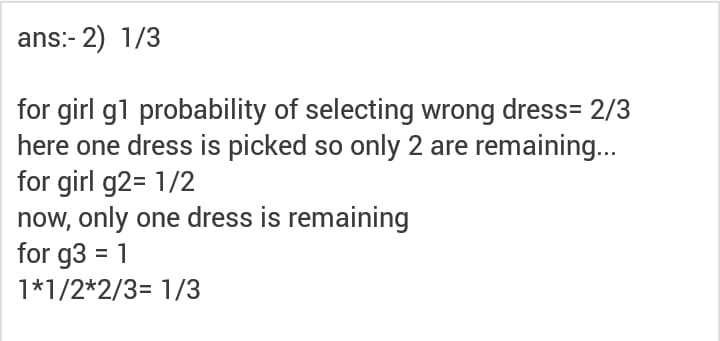
Apply the subfactorial formula for n = 3: !3 = 3!(1 - 1/1! + 1/2! - 1/3!) = 6 × (1 - 1 + 1/2 - 1/6) = 6 × 1/3 = 2.
So exactly 2 of the 6 equally likely arrangements leave every daughter without her own dress.
Probability = favourable derangements / total arrangements = 2/6 = 1/3.
Cross-check: list every arrangement directly and mark whether each daughter A, B, C keeps her own dress (a, b, c respectively).
Arrangement of dresses to (A, B, C) | Any own dress kept? | Derangement? |
|---|---|---|
(a, b, c) | All three keep their own dress | No |
(a, c, b) | A keeps her own dress | No |
(b, a, c) | C keeps her own dress | No |
(b, c, a) | None keep their own dress | Yes |
(c, a, b) | None keep their own dress | Yes |
(c, b, a) | B keeps her own dress | No |
Exactly 2 of the 6 arrangements — (b, c, a) and (c, a, b) — are derangements, confirming probability = 2/6 = 1/3.
Reference working: