A 6 faced die is so biased that it is twice as likely to show an even number…
2025
A 6 faced die is so biased that it is twice as likely to show an even number as an odd, if it is thrown twice what is the probability that the sum of the numbers is even ?
- A.
1/3
- B.
2/3
- C.
5/9
- D.
6/11
Show answer & explanation
Correct answer: C
Concept
When two events are independent, the probability that both occur is the product of their individual probabilities, and the probabilities of mutually exclusive ways to reach the same outcome add. For two dice throws, the sum of the two results is even exactly when both throws share the same parity — both even or both odd — since even+even and odd+odd are even, while even+odd is always odd.
Step-by-step
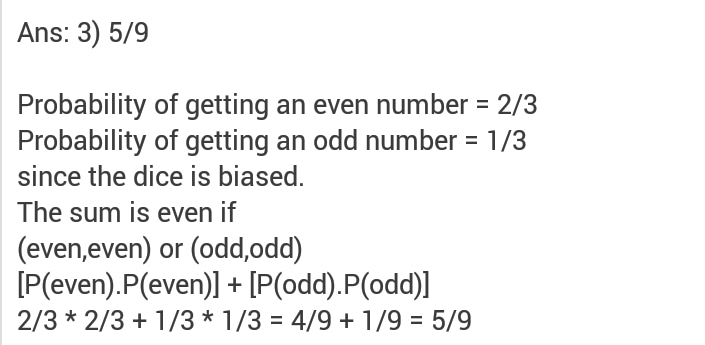
The die is biased so an even face is twice as likely as an odd face. Since P(even) + P(odd) = 1 and P(even) = 2·P(odd), solving gives P(odd) = 1/3 and P(even) = 2/3.
The sum of the two throws is even only in two mutually exclusive cases: both throws even, or both throws odd.
Since the two throws are independent, P(both even) = P(even) × P(even) = 2/3 × 2/3 = 4/9.
Similarly, P(both odd) = P(odd) × P(odd) = 1/3 × 1/3 = 1/9.
Adding the two mutually exclusive cases: P(sum is even) = 4/9 + 1/9 = 5/9.
Cross-check
P(sum is odd) should equal 1 − 5/9 = 4/9. Directly, an odd sum needs one even and one odd throw, in either order: P(even,odd) + P(odd,even) = 2 × (2/3 × 1/3) = 4/9 — matching the complement and confirming 5/9 is correct.
Reference working: