Find the probability that a 3-digit number formed by digits 1, 3, 6, 9 (with…
2024
Find the probability that a 3-digit number formed by digits 1, 3, 6, 9 (with no repetition) is divisible by 4.
- A.
1/5
- B.
1/4
- C.
1/6
- D.
1/3
Attempted by 2 students.
Show answer & explanation
Correct answer: B
Concept: A number is divisible by 4 if and only if the two-digit number formed by its last two digits is divisible by 4 — the divisibility rule for 4 depends only on the tens and units digits, not on any digit before them. Probability here equals the number of favorable 3-digit arrangements divided by the total number of equally likely 3-digit arrangements of the given digits.
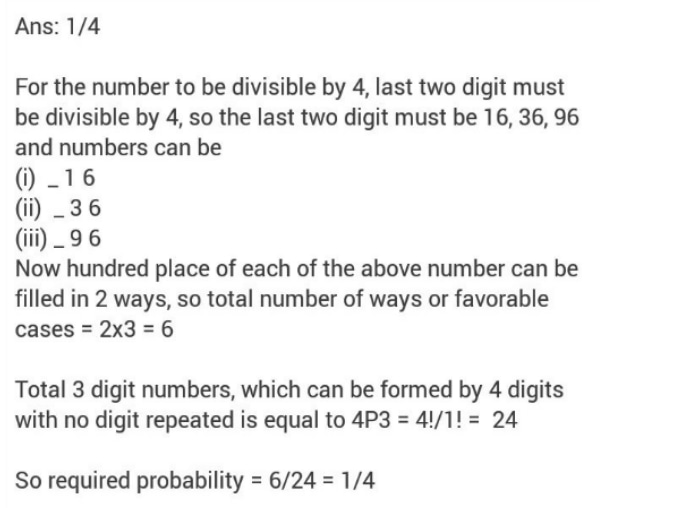
Application: Total outcomes = the number of ways to arrange 3 of the 4 digits {1, 3, 6, 9} in order = 4 × 3 × 2 = 24. To count the favorable arrangements, test every two-digit combination of two distinct digits from {1, 3, 6, 9} for divisibility by 4:
13, 19, 31, 39, 61, 63, 69, 91, 93 are not divisible by 4.
16 is divisible by 4 (16 ÷ 4 = 4); 36 is divisible by 4 (36 ÷ 4 = 9); 96 is divisible by 4 (96 ÷ 4 = 24) — these are the three qualifying two-digit endings.
For each qualifying ending, the leading (hundreds) digit must be one of the two digits not already used in that ending, giving 2 choices per ending.
Favorable arrangements = 3 qualifying endings × 2 leading-digit choices = 6.
So probability = favorable / total = 6/24 = 1/4.
Cross-check: Listing the 6 numbers directly confirms the count: 136, 196, 316, 396, 916, 936 — each of these divides evenly by 4 (for example, 936 ÷ 4 = 234), and no other arrangement of three digits from {1, 3, 6, 9} does.