A pair of 8-sided dice has sides numbered 1 to 8. Each side has the same…
2026
A pair of 8-sided dice has sides numbered 1 to 8. Each side has the same probability of landing face up. The probability that the product of the two numbers that land face up exceeds 36 is:
- A.
5/32
- B.
3/8
- C.
3/16
- D.
1/4
Attempted by 2 students.
Show answer & explanation
Correct answer: A
Concept: Classical probability equals the number of favorable outcomes divided by the total number of equally likely outcomes. When two dice are rolled, every face of the first die can pair with every face of the second, so the total outcomes equal (faces on die 1) × (faces on die 2).
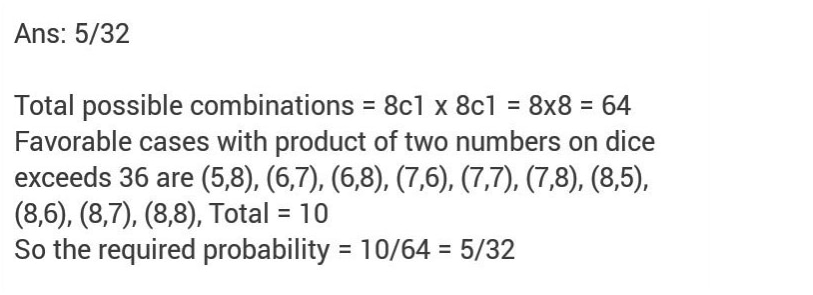
Application: Total outcomes = 8 × 8 = 64, since each die has 8 faces. To count the pairs (a, b) whose product exceeds 36, check each value of the first die a against the required range for the second die b:
a = 1, 2, 3, or 4: even the largest possible second value b = 8 gives a product of at most 32, which never exceeds 36 — 0 favorable pairs for each of these.
a = 5: b must be greater than 36/5 = 7.2, so only b = 8 qualifies — 1 pair.
a = 6: b must be greater than 6, so b = 7 or 8 qualify — 2 pairs.
a = 7: b must be greater than 36/7 ≈ 5.14, so b = 6, 7, or 8 qualify — 3 pairs.
a = 8: b must be greater than 4.5, so b = 5, 6, 7, or 8 qualify — 4 pairs.
Adding these counts: 0 + 0 + 0 + 0 + 1 + 2 + 3 + 4 = 10 favorable ordered pairs — (5,8), (6,7), (6,8), (7,6), (7,7), (7,8), (8,5), (8,6), (8,7), (8,8). So the probability = 10/64 = 5/32.
Cross-check: The pair (6,6) gives a product of exactly 36, which does not exceed 36, so it is correctly left out; the pair (8,8) gives the maximum possible product of 64, correctly included. Because the two dice are distinguishable, both orders of an unequal pair (such as (6,7) and (7,6)) are separately counted among the 64 total outcomes, matching the list above.