A six faced die is so biased that it is twice as likely to show an even number…
2026
A six faced die is so biased that it is twice as likely to show an even number as an odd. It is thrown twice. What is the probability that the sum of the numbers is even?
- A.
1/3
- B.
2/3
- C.
5/9
- D.
6/11
Attempted by 4 students.
Show answer & explanation
Correct answer: C
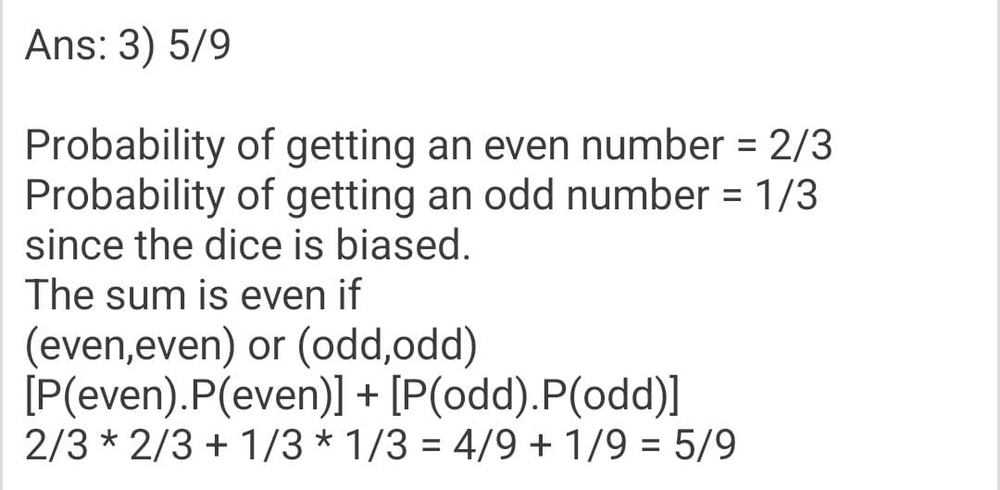
Concept: When two independent trials each land "even" with probability pe and "odd" with probability po = 1 − pe, the sum of the two outcomes is even precisely when both trials match in parity — both even or both odd. So P(sum is even) = pe2 + po2.
The die is twice as likely to show an even number as an odd number, so assign probability p to each odd face and 2p to each even face.
A standard six-faced die has 3 odd faces (1, 3, 5) and 3 even faces (2, 4, 6). All face probabilities must sum to 1: 3p + 3(2p) = 9p = 1, so p = 1/9.
The probability of an odd face on one throw is P(odd) = 3p = 1/3, and the probability of an even face is P(even) = 3(2p) = 2/3.
Applying the concept: P(sum even) = P(even)2 + P(odd)2 = (2/3)2 + (1/3)2 = 4/9 + 1/9 = 5/9.
Cross-check: the sum is odd only when the two throws have different parity, which happens with probability 2 × P(even) × P(odd) = 2 × (2/3) × (1/3) = 4/9. Adding the even-sum and odd-sum cases gives 5/9 + 4/9 = 1, confirming the computation is consistent.