When 3 dice are rolled, what is the probability that the sum of the numbers…
2024
When 3 dice are rolled, what is the probability that the sum of the numbers obtained is 13?
- A.
5/108
- B.
7/72
- C.
7/216
- D.
5/72
Attempted by 3 students.
Show answer & explanation
Correct answer: B
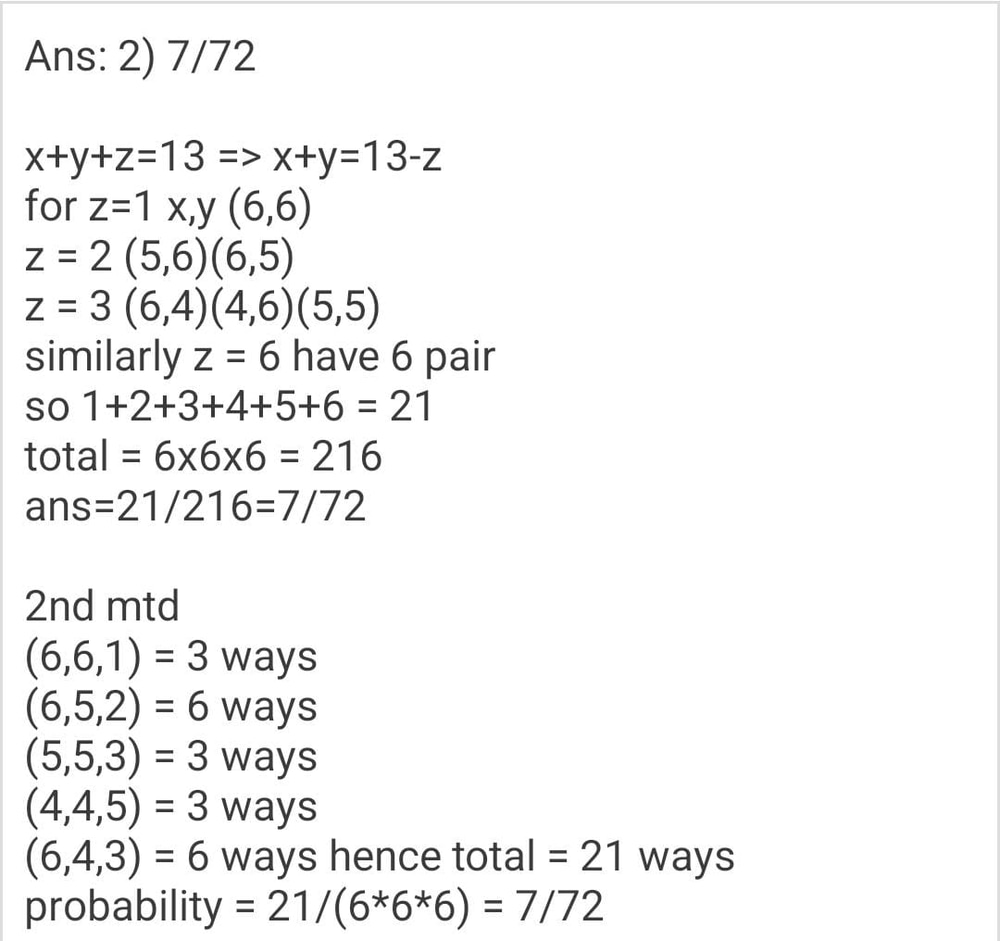
For a finite sample space of equally likely outcomes, the probability of an event equals the number of favourable outcomes divided by the total number of outcomes. When n fair dice are rolled together, each die independently shows one of 6 faces, so the total number of equally likely outcomes is 6 raised to the power n. To find a probability like ‘sum equals a given value’, count how many ordered outcomes (one value per die) produce that sum.
Total outcomes for 3 dice: 63 = 216.
List every unordered combination of three values from 1–6 that adds to 13: {6,6,1}, {6,5,2}, {6,4,3}, {5,5,3}, {5,4,4}.
Count the ordered arrangements of each combination: a combination with all three values different has 3! = 6 arrangements; a combination with exactly two equal values has 3 arrangements. So {6,6,1} gives 3, {6,5,2} gives 6, {6,4,3} gives 6, {5,5,3} gives 3, and {5,4,4} gives 3.
Add the arrangements: 3+6+6+3+3 = 21 favourable outcomes.
Probability = 21/216, which simplifies (dividing numerator and denominator by 3) to 7/72.
Cross-check (independent method): The sum distribution of three dice is symmetric about 10.5, because replacing each die's value v with (7 − v) turns a sum of s into a sum of (21 − s), while keeping every outcome equally likely. So the count for a sum of 13 must equal the count for a sum of 21 − 13, which is 8. Repeating the same combination-and-arrangement count for a sum of 8 — {1,1,6}, {1,2,5}, {1,3,4}, {2,2,4}, {2,3,3} with 3, 6, 6, 3, 3 arrangements respectively — again gives 21, confirming the result.