How many positive integers less than 700 can be formed using the digits 2, 4,…
2026
How many positive integers less than 700 can be formed using the digits 2, 4, 6, and 7, if each digit is used only once?
- A.
50
- B.
44
- C.
38
- D.
34
Attempted by 2 students.
Show answer & explanation
Correct answer: D
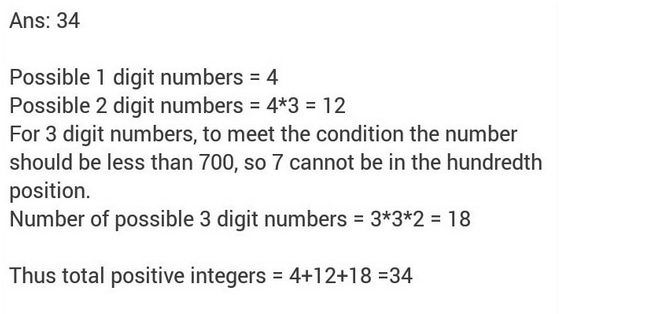
Concept: To count integers below a given bound that can be formed from a fixed set of digits without repetition, split the count by number of digits used. For each digit-length k, the number of valid arrangements is a permutation ⁿPₖ = n × (n−1) × … × (n−k+1); when the bound restricts which digit can occupy the leading place, only the allowed leading digits are counted for that digit-length, and the totals across digit-lengths are added.
Working:
One-digit numbers: any of the 4 digits {2, 4, 6, 7} standing alone is a valid 1-digit number, and every 1-digit number is automatically less than 700. Count = 4P1 = 4.
Two-digit numbers: choose an ordered pair of distinct digits from the 4 available digits (each digit used at most once). Count = 4P2 = 4 × 3 = 12. Every 2-digit number formed this way is well below 700, so no extra restriction applies here.
Three-digit numbers: here the bound matters — a 3-digit number is below 700 only if its hundreds digit is less than 7, so the hundreds place can only be 2, 4, or 6 (3 choices). Once the hundreds digit is fixed, the remaining two places are filled by an ordered arrangement of the 3 leftover digits: 3P2 = 3 × 2 = 6. Count = 3 × 6 = 18.
Add the three cases: 4 + 12 + 18 = 34.
Cross-check: Ignoring the bound, all 3-digit arrangements of the 4 digits number 4P3 = 4 × 3 × 2 = 24. Exactly those with 7 in the hundreds place (1 choice for hundreds × 3P2 = 6 arrangements for the rest = 6 numbers) exceed the bound, leaving 24 − 6 = 18 valid 3-digit numbers — matching the count above, so the total of 34 stands confirmed.