A owes B Rs. 60. He agrees to pay B over a number of consecutive days starting…
2024
A owes B Rs. 60. He agrees to pay B over a number of consecutive days starting on a Monday, paying a single note of Rs. 10 or Rs. 20 each day. In how many different ways can A repay B? (Two ways are considered different if on at least one day, a note of a different denomination is given.)
- A.
11
- B.
15
- C.
16
- D.
13
Attempted by 2 students.
Show answer & explanation
Correct answer: D
Concept
When a total amount is built up as a sequence of days, each day contributing one of two fixed-denomination notes, the number of distinct day-by-day sequences for a fixed count of notes of each type equals the number of ways to choose which days carry the larger-denomination note, i.e. nCr, where n is the total notes used and r is how many of one denomination appear. When several different note-count splits can all reach the target sum, sum the arrangements over every valid split.
Step-by-Step Solution
Let x = number of Rs. 10 notes and y = number of Rs. 20 notes used. Since the total must be Rs. 60: 10x + 20y = 60, i.e. x + 2y = 6.
List every non-negative integer solution (x, y): (6, 0), (4, 1), (2, 2), (0, 3).
For each split, the total number of notes is n = x + y, and the distinct day-sequences equal the number of ways to place the Rs. 20 notes among the n days, i.e. nCy.
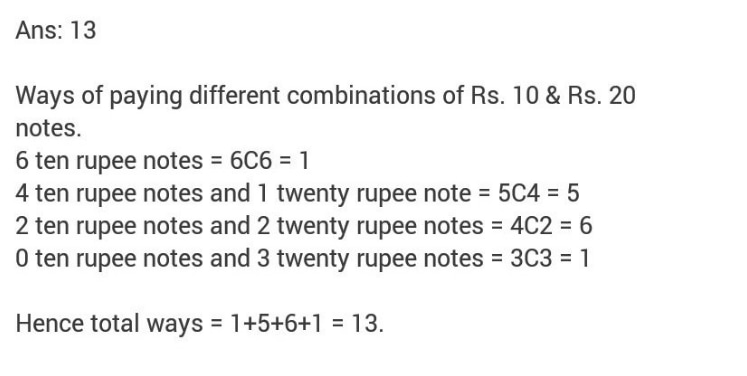
(x, y) = (6, 0): n = 6, arrangements = 6C0 = 1.
(x, y) = (4, 1): n = 5, arrangements = 5C1 = 5.
(x, y) = (2, 2): n = 4, arrangements = 4C2 = 6.
(x, y) = (0, 3): n = 3, arrangements = 3C3 = 1.
Add the arrangements across all four splits: 1 + 5 + 6 + 1 = 13.
Cross-Check
An independent recurrence confirms this: let f(n) be the number of note-sequences that sum to 10n rupees using a single Rs. 10 or Rs. 20 note per day. Each sequence's last day is either a Rs. 10 note (leaving f(n-1) ways for the remaining days) or a Rs. 20 note (leaving f(n-2) ways), so f(n) = f(n-1) + f(n-2), with f(0) = 1 and f(1) = 1. Building up: f(2)=2, f(3)=3, f(4)=5, f(5)=8, f(6)=13, matching the case-by-case total for Rs. 60 (n = 6).