2/3rd of the balls in a bag are blue , the rest are pink . If 5/9th of the…
2024
2/3rd of the balls in a bag are blue , the rest are pink . If 5/9th of the blue balls and 7/8th of the pink balls are defective , find the total number of balls in the bag given that the number of non - defective balls is 146.
- A.
455
- B.
450
- C.
469
- D.
432
Attempted by 17 students.
Show answer & explanation
Correct answer: D
Concept: When a total is split into two groups by fixed fractions, and each group has its own defective/non-defective fraction, the overall non-defective count is the weighted sum of each group's own non-defective fraction of the total. Setting this sum equal to the given non-defective count and solving for the total (using an LCM to combine the fractions) is the standard way to solve such part-whole problems.
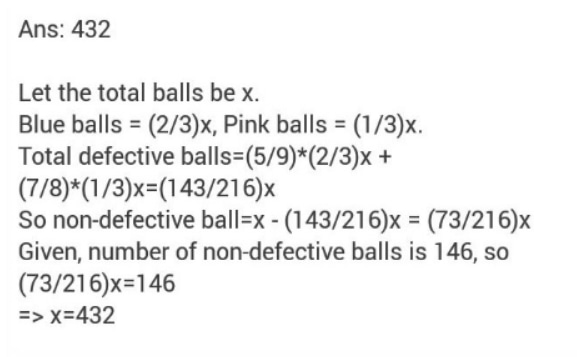
Let the total number of balls be x. Blue balls = 2/3 x and pink balls = 1/3 x.
5/9 of the blue balls are defective, so the non-defective fraction of blue is 4/9. Non-defective blue = 4/9 × 2/3 x = 8/27 x.
7/8 of the pink balls are defective, so the non-defective fraction of pink is 1/8. Non-defective pink = 1/8 × 1/3 x = 1/24 x.
Total non-defective = 8/27 x + 1/24 x. Taking LCM(27, 24) = 216: 8/27 = 64/216 and 1/24 = 9/216, so the sum is 73/216 x.
Given non-defective balls = 146, so 73/216 x = 146, which gives x = 146 × 216/73 = 432.
Cross-check: With 432 total balls, blue = 288 (non-defective = 4/9 × 288 = 128) and pink = 144 (non-defective = 1/8 × 144 = 18). Together, 128 + 18 = 146, matching the given condition exactly.