If SEND + MORE = MONEY then find M + O + N + E + Y
2024
If SEND + MORE = MONEY then find M + O + N + E + Y
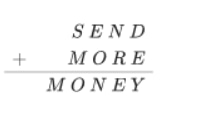
- A.
19
- B.
17
- C.
14
- D.
15
Attempted by 6 students.
Show answer & explanation
Correct answer: C
Concept: In a cryptarithmetic (alphametic) puzzle, each distinct letter stands for one unique digit (0-9), no leading letter can be 0, and the letters must satisfy the sum when the words are added in ordinary place-value form. Working column by column from the units place: the digit written in a column is (that column's sum, including any carry-in) mod 10, and a carry of 1 passes into the next column whenever the column's sum reaches 10 or more. Adding two 4-digit numbers can produce at most a 5-digit result, so any extra leading digit created is always 1.
Application:
SEND (4 digits) + MORE (4 digits) = MONEY (5 digits), so the extra leading digit is 1: M = 1.
In the thousands column, S + M, plus any carry arriving from the hundreds column, must produce a value whose tens digit becomes the new leading digit of MONEY (already fixed as M = 1) and whose units digit is O. Since S is at most 9, M = 1, and the incoming carry is at most 1, this total is at most 11 — so it equals either 10 or 11, making O either 0 or 1. O cannot equal M (= 1), so O = 0, and S + 1 + (carry from hundreds) = 10.
Test a carry of 1 arriving from the hundreds column (this would give S = 8). This carry equals the carry out of the hundreds column, so the hundreds column satisfies E + O + (carry into hundreds) = N + 10, i.e. (with O = 0) N = E + (carry into hundreds) − 10. Since E is at most 9 and the carry into hundreds is at most 1, the right side is at most 0, forcing N = 0 — but O is already 0, a duplicate digit. This is impossible, so the carry from hundreds is not 1; it is 0, and S = 9.
With the carry out of the hundreds column equal to 0, the hundreds column gives E + O + (carry into hundreds) = N. With O = 0, this is E + (carry into hundreds) = N. Since N cannot equal E, the carry into hundreds must be 1, so N = E + 1.
The carry into the hundreds column (= 1) is the carry out of the tens column, so the tens column gives N + R + (carry into tens) = E + 10. Substituting N = E + 1: R = E + 10 − N − (carry into tens) = 9 − (carry into tens). If the carry into tens were 0, R would be 9, clashing with S = 9, so the carry into tens is 1, giving R = 8.
The carry into the tens column (= 1) is the carry out of the units column, so the units column gives D + E = Y + 10.
The digits already fixed are M = 1, O = 0, S = 9, R = 8. The remaining letters E, N (= E + 1), D, and Y must be four distinct digits from {2,3,4,5,6,7} satisfying D + E = Y + 10. Checking each possible value of E from 2 to 6 in turn, the only one that gives D and Y both inside {2,3,4,5,6,7} and distinct from E and N is E = 5 (N = 6), which gives D = 7 and Y = 2.
This fixes every letter uniquely: S = 9, E = 5, N = 6, D = 7, M = 1, O = 0, R = 8, Y = 2 — so SEND = 9567, MORE = 1085, and MONEY = 10652.
Letter | Digit |
|---|---|
S | 9 |
E | 5 |
N | 6 |
D | 7 |
M | 1 |
O | 0 |
R | 8 |
Y | 2 |
Cross-check: 9567 + 1085 = 10652, confirming the assignment holds for the full addition, not just for individual columns.
So M + O + N + E + Y = 1 + 0 + 6 + 5 + 2 = 14.