Amar packs 304 marbles into packets of 9 or 11, so that no marble is left.…
2025
Amar packs 304 marbles into packets of 9 or 11, so that no marble is left. Amar wants to maximize the number of bags with 9 marbles. How many bags does he need, if there should be at least one bag with 11 marbles?
- A.
30
- B.
34
- C.
32
- D.
28
Attempted by 3 students.
Show answer & explanation
Correct answer: C
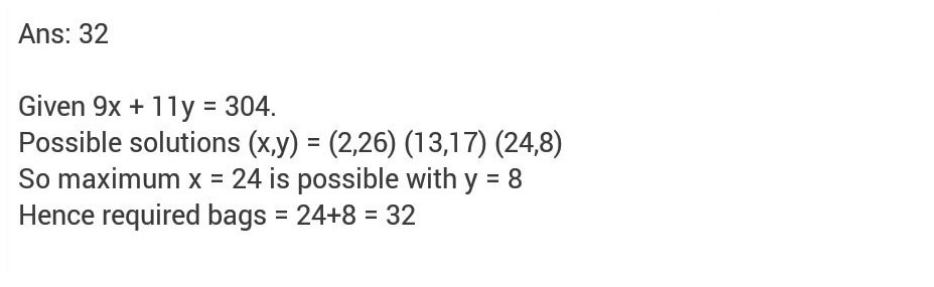
CONCEPT: For a linear Diophantine equation ax + by = N with positive integer coefficients a, b, the integer solutions (x, y) form a sequence spaced at fixed steps -- once one solution is found, every next solution increases x by b/gcd(a,b) while decreasing y by a/gcd(a,b) (or vice versa). So the maximum (or minimum) value of one variable, subject to a range constraint on the other, is found by stepping through this sequence.
Let x = number of 9-marble bags and y = number of 11-marble bags. Then 9x + 11y = 304, with x >= 0 and y >= 1 (since at least one 11-marble bag is required).
Reduce modulo 9: 11y = 304 (mod 9) becomes 2y = 7 (mod 9), since 11 = 2 (mod 9) and 304 = 7 (mod 9). The inverse of 2 modulo 9 is 5, so y = 7*5 = 35 = 8 (mod 9). The smallest valid y is 8, and each next solution increases y by 9: y = 8, 17, 26, ...
For each valid y, compute x = (304 - 11y)/9: y = 8 gives x = 24 (total bags = 32); y = 17 gives x = 13 (total bags = 30); y = 26 gives x = 2 (total bags = 28); y = 35 would need 11 times 35 = 385, which exceeds 304, so it is invalid.
To maximize x (the number of 9-marble bags), pick the smallest valid y, which is y = 8, giving x = 24. Total bags needed = x + y = 24 + 8 = 32.
CHECK: 9(24) + 11(8) = 216 + 88 = 304, matching the total marble count, with at least one 11-marble bag as required.