If m + n is divided by 12, the remainder is 8, and if m − n is divided by 12,…
2025
If m + n is divided by 12, the remainder is 8, and if m − n is divided by 12, the remainder is 6. Given that m > n, find the remainder when mn is divided by 6.
- A.
1
- B.
2
- C.
3
- D.
4
Attempted by 5 students.
Show answer & explanation
Correct answer: A
Concept: When a number a leaves remainder r on division by n (written a ≡ r (mod n)), it can be written as a = kn + r for some integer k. This turns a remainder condition into an algebraic equation, and lets the remainder of a sum, difference, or product of two numbers be found directly from their individual remainders — without needing the numbers themselves.
Applying this to m and n:
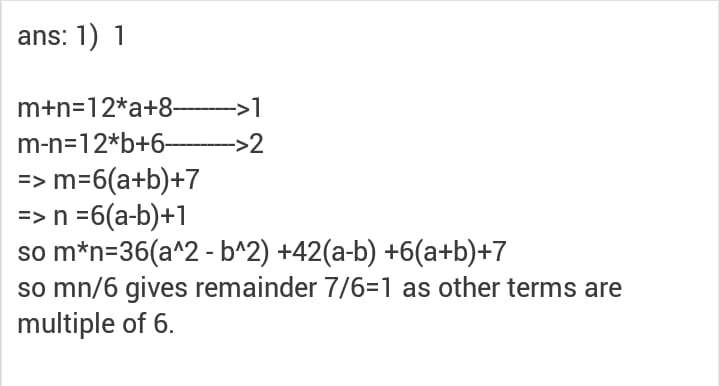
From “m + n divided by 12 leaves remainder 8”: m + n = 12a + 8, for some integer a ≥ 0.
From “m − n divided by 12 leaves remainder 6” (m > n, so m − n > 0): m − n = 12b + 6, for some integer b ≥ 0.
Adding the two equations: 2m = 12a + 12b + 14, so m = 6(a + b) + 7.
Since 6(a + b) is exactly divisible by 6, m mod 6 = 7 mod 6 = 1.
Subtracting the two equations: 2n = 12a − 12b + 2, so n = 6(a − b) + 1.
Since 6(a − b) is exactly divisible by 6, n mod 6 = 1.
Therefore mn mod 6 = (m mod 6) × (n mod 6), all mod 6 = (1 × 1) mod 6 = 1.
Cross-check: Take a = 0, b = 0 (the smallest valid case): m = 7, n = 1. Check: m + n = 8 (remainder 8 on division by 12, correct); m − n = 6 (remainder 6 on division by 12, correct); m > n, correct. Then mn = 7 × 1 = 7, and 7 divided by 6 leaves remainder 1, confirming the result. A second case, a = 1, b = 0, gives m = 13, n = 7, mn = 91, and 91 divided by 6 also leaves remainder 1.
Result: The remainder when mn is divided by 6 is 1.