What is the remainder when the 400-digit number formed by repeating the…
2025
What is the remainder when the 400-digit number formed by repeating the 4-digit block 1234 exactly 100 times (i.e., 1234123412341234… written out to 400 digits) is divided by 909?
- A.
0
- B.
1
- C.
675
- D.
685
Attempted by 4 students.
Show answer & explanation
Correct answer: D
A number built by repeating a fixed block of digits many times over is really that block's value added to itself at every place shift — once for each repetition — so its size can be written as the block's value multiplied by a sum of successive powers of ten.
To find the remainder such a number leaves on division by some fixed modulus, first find what a single one of those repeating powers of ten itself leaves as a remainder. If that basic power already leaves a remainder of exactly one, every one of the equally-spaced powers in the sum behaves the same way, so the whole sum simply reduces to the number of repetitions.
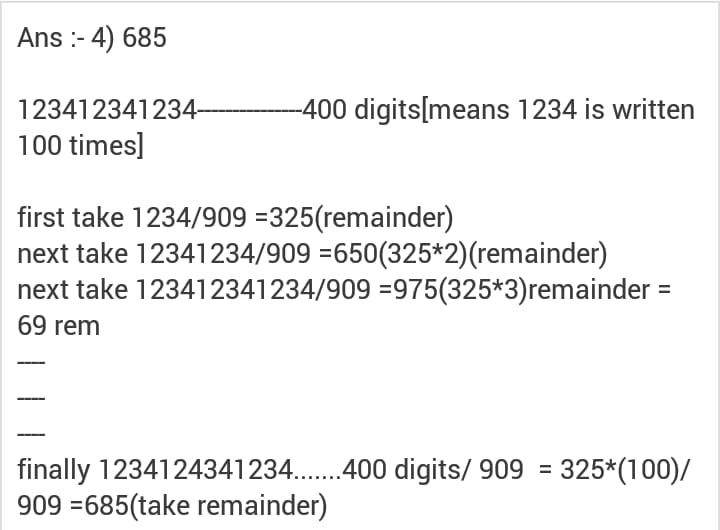
The number has 400 digits and repeats the 4-digit block 1234, so it is made of exactly 100 copies of that block (400 ÷ 4 = 100).
Writing the number as a sum: N = 1234 × (1 + 104 + 108 + … + 10396) — one power of ten for each of the 100 positions where a copy of the block begins.
First reduce the basic power: 104 = 10000, and 10000 = 909 × 11 + 1, so 104 leaves remainder 1 on division by 909.
Because the basic power already leaves remainder 1, every other power in the sum (108, 1012, and so on, all the way to 10396) also leaves remainder 1 — so the sum of all 100 such powers leaves remainder 100 on division by 909.
So N leaves the same remainder as 1234 × 100 = 123400 on division by 909.
Dividing 123400 by 909: 909 × 135 = 122715, and 123400 − 122715 = 685 — the remainder.
As an independent check, reduce 1234 by 909 first: 1234 − 909 = 325. Then 325 × 100 = 32500, and 32500 − (909 × 35 = 31815) = 685 — the same remainder.
So the remainder is 685.