The average weight of the students in four sections A, B, C and D is 55 kg.…
2024
The average weight of the students in four sections A, B, C and D is 55 kg. The average weights of the students of sections A, B, C and D are 45 kg, 40 kg, 75 kg and 85 kg respectively. If the average weight of the students of sections A and D together is 65 kg and that of B and D together is 55 kg, then what is the ratio of the number of students in A and C?
- A.
5 : 1
- B.
6 : 1
- C.
2 : 1
- D.
8 : 1
Attempted by 3 students.
Show answer & explanation
Correct answer: C
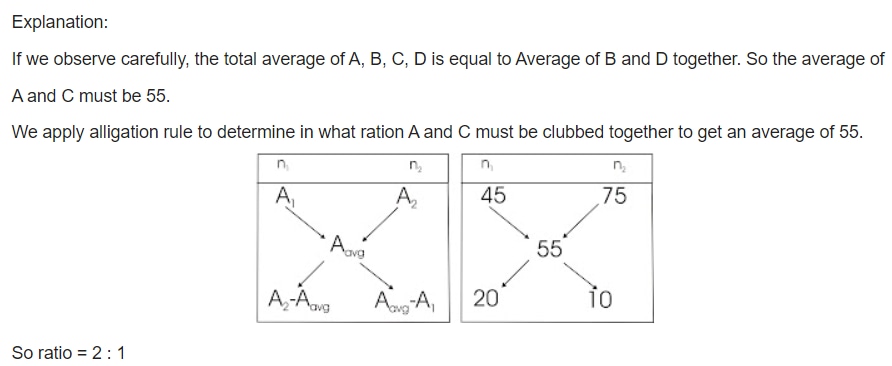
Concept: For two groups combined into one, if each group has its own average and the combined group has a known overall average, the ratio of the group sizes is fixed by the alligation (weighted-mean) rule: (group with the smaller average) : (group with the larger average) = (larger average − combined average) : (combined average − smaller average). This follows directly from the weighted-mean equation n₁a₁ + n₂a₂ = (n₁+n₂)·Aavg.
Application: Let nA, nB, nC, nD be the number of students in sections A, B, C and D, with individual average weights 45 kg, 40 kg, 75 kg and 85 kg respectively.
The overall average weight of all four sections is 55 kg, so the total weight equals 55 × (nA + nB + nC + nD).
The average weight of sections B and D together is also given as 55 kg, so their combined weight equals 55 × (nB + nD).
Subtracting the second total from the first gives the combined weight of sections A and C as 55 × (nA + nC) — so the average weight of A and C together is exactly 55 kg, the same as the overall average.
Applying the alligation rule to A (average 45 kg) and C (average 75 kg) against the 55 kg mean: nA : nC = (75 − 55) : (55 − 45) = 20 : 10 = 2 : 1.
Cross-check: The A–D and B–D averages given in the question independently confirm the same ratio when the section sizes are solved for directly.
From the A–D average of 65 kg: 45·nA + 85·nD = 65·(nA + nD), which simplifies to nD = nA.
From the B–D average of 55 kg: 40·nB + 85·nD = 55·(nB + nD), which simplifies to nB = 2·nD = 2·nA.
Substituting nD = nA and nB = 2nA into the overall-average equation 45nA + 40nB + 75nC + 85nD = 55·(nA+nB+nC+nD) gives 210nA + 75nC = 220nA + 55nC, i.e. 20nC = 10nA.
This again gives nA : nC = 2 : 1, matching the alligation result above.
So the ratio of the number of students in sections A and C is 2 : 1.