A beaker has 50% wine (with the rest water) and a second beaker, whose…
2025
A beaker has 50% wine (with the rest water) and a second beaker, whose capacity is twice the first beaker's, contains 25% wine (with the rest water). Both are poured into a third beaker. What fraction of wine does the third beaker contain?
- A.
1/2
- B.
2/3
- C.
1/4
- D.
1/3
Attempted by 7 students.
Show answer & explanation
Correct answer: D
When two mixtures of different concentrations are combined, the concentration of the resulting mixture is the weighted average of the individual concentrations, weighted by each mixture's own volume — not a simple average of the two percentages. This is the core mixture/alligation principle: total quantity of the substance divided by total quantity of the mixture.
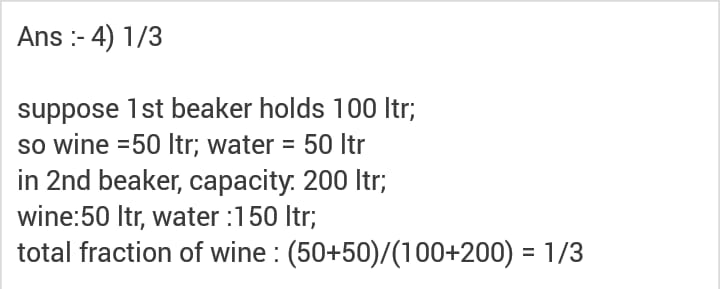
Let the first beaker's capacity be V litres (take V = 100 L for clean arithmetic).
The first beaker is 50% wine, so it contributes 0.5 x 100 = 50 L of wine (and 50 L of water).
The second beaker's capacity is twice the first, i.e. 2V = 200 L, and is 25% wine, so it contributes 0.25 x 200 = 50 L of wine (and 150 L of water).
Pouring both into the third beaker gives a total wine quantity of 50 + 50 = 100 L, in a total mixture volume of 100 + 200 = 300 L.
The fraction of wine in the third beaker is 100/300 = 1/3.
Equivalently, by the weighted-average (alligation) rule: since the two volumes are in ratio 1 : 2, the combined percentage is (1x50 + 2x25)/(1+2) = 100/3 % (about 33.3%), i.e. 1/3 — confirming the same result via a second method.