The minimum number of cuts required to cut a big cube into 480 identical…
2025
The minimum number of cuts required to cut a big cube into 480 identical pieces is n. What is the maximum number of identical pieces that can be cut from the big cube with n cuts ?
- A.
480
- B.
512
- C.
492
- D.
576
Attempted by 4 students.
Show answer & explanation
Correct answer: B
Concept
When a cube is cut by planes parallel to its faces — a cuts along one edge-direction, b along the second, c along the third — it is divided into (a+1)(b+1)(c+1) identical smaller cuboids, using a total of a+b+c cuts. For a fixed product, the sum of the three factors is smallest when the factors are as close to equal as possible; for a fixed sum, the product of the three factors is largest when the factors are equal (both are direct consequences of AM–GM).
Step-by-step solution
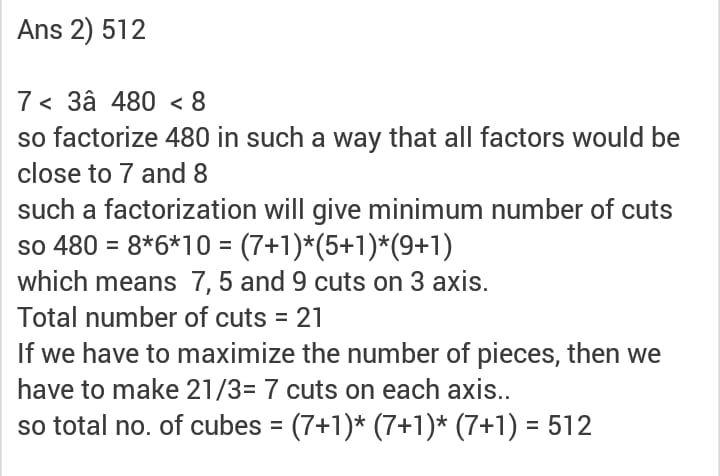
Write 480 as a product of three positive integers that are as close to each other as possible (cube root of 480 ≈ 7.83).
480 = 6 × 8 × 10, so the cuts needed along the three directions are 5, 7 and 9. Minimum total cuts n = 5 + 7 + 9 = 21.
The same 21 cuts must now be split across the three directions as p, q, r cuts (p + q + r = 21) to maximise the piece count (p+1)(q+1)(r+1). Writing P = p+1, Q = q+1, R = r+1, the sum P + Q + R = 24 stays fixed regardless of the split, so the product P × Q × R is largest when P = Q = R.
24 ÷ 3 = 8 exactly, so P = Q = R = 8, giving the maximum piece count = 8³ = 512.
Cross-check
Minimum-cut check: the next closest factor triple of 480 is 5 × 8 × 12, needing 4+7+11 = 22 cuts — one more than 21, confirming 21 is indeed minimal. Maximum-piece check: an uneven split of the same 21 cuts, e.g. 6, 7, 8 cuts per direction (P, Q, R = 7, 8, 9, still summing to 24), gives only 7 × 8 × 9 = 504 pieces — fewer than 512, confirming the equal split is optimal.