The total expenses of a boarding house are partly fixed and partly variable…
2024
The total expenses of a boarding house are partly fixed and partly variable with the number of boarders. The charge is Rs 48 per head when there are 75 boarders, and Rs 52 per head when there are 50 boarders. Find the charge per head when there are 100 boarders.
- A.
Rs 44
- B.
Rs 50
- C.
Rs 42
- D.
Rs 46
Attempted by 7 students.
Show answer & explanation
Correct answer: D
Concept: When a total cost has a fixed part and a part that varies with the number of units, Total Cost = a + kn, where a is the fixed cost, k is the variable cost per unit, and n is the number of units. The cost per unit (charge per head) is then a/n + k, which falls as n grows -- because the fixed cost gets spread over more units -- and approaches k as n becomes very large.
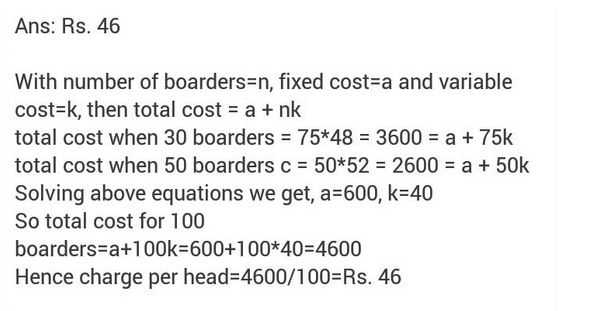
Application: Let the fixed cost be a and the variable cost per boarder be k, so Total Cost = a + kn.
With 75 boarders the charge is Rs 48 per head, so the total cost is 75 x 48 = 3600. This gives the equation a + 75k = 3600.
With 50 boarders the charge is Rs 52 per head, so the total cost is 50 x 52 = 2600. This gives the equation a + 50k = 2600.
Subtracting the second equation from the first eliminates a: (a + 75k) - (a + 50k) = 3600 - 2600, so 25k = 1000, giving k = 40.
Substituting k = 40 into a + 50k = 2600 gives a + 2000 = 2600, so a = 600.
For 100 boarders, the total cost is a + 100k = 600 + 100 x 40 = 600 + 4000 = 4600, so the charge per head is 4600 / 100 = Rs 46.
Cross-check: Using the per-head formula a/n + k = 600/n + 40 directly: at n = 75 it gives 8 + 40 = 48 (matches); at n = 50 it gives 12 + 40 = 52 (matches); at n = 100 it gives 6 + 40 = 46, confirming the answer independently of the substitution steps above. This also matches the expected trend -- as the number of boarders rises (50, then 75, then 100), the charge per head keeps falling (52, then 48, then 46) since the fixed cost is shared over more people.