Mahesh calculated his average over the last 24 tests and found it to be 76. He…
2026
Mahesh calculated his average over the last 24 tests and found it to be 76. He finds out that the marks for three tests have been inverted by mistake. The correct marks for these are 87, 79 and 98. What is the difference between his actual average and his incorrect average?
- A.
1.75
- B.
2.25
- C.
2.15
- D.
No difference
Attempted by 5 students.
Show answer & explanation
Correct answer: D
Concept: Average = (sum of all values) ÷ (number of values). If one set of values in the sum is replaced by another set whose TOTAL is exactly the same, the overall sum — and therefore the average — does not change at all, no matter how different the individual values look.
Apply this to Mahesh's 24 tests:
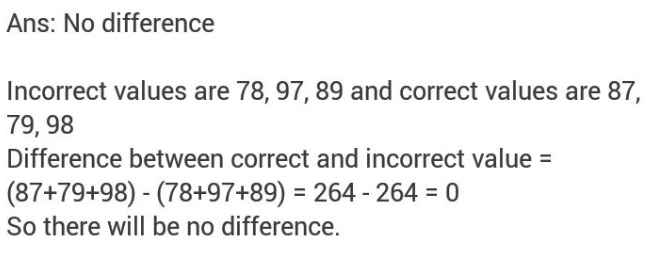
The three CORRECT marks are 87, 79 and 98. Their sum = 87 + 79 + 98 = 264.
Because the marks were “inverted” (the two digits of each two-digit mark were swapped), the marks that were actually recorded are 78 (from 87), 97 (from 79) and 89 (from 98).
Sum of the recorded (incorrect) marks = 78 + 97 + 89 = 264.
Both sums are identical (264 = 264), so replacing the incorrect marks with the correct ones does not change the total of all 24 marks at all.
Since the total is unchanged and the count of tests (24) is unchanged, the average is unchanged too: actual average − incorrect average = 0 ÷ 24 = 0.
Cross-check: For any two-digit number with tens digit t and units digit u, swapping the digits changes its value by exactly 9(t − u). For 87 (t=8,u=7): 9(8−7)=9. For 79 (t=7,u=9): 9(7−9)=−18. For 98 (t=9,u=8): 9(9−8)=9. Summing these three individual changes: 9 − 18 + 9 = 0, independently confirming the net change across the three marks is zero.