The average marks of three students A, B and C is 70 . When another student D…
2024
The average marks of three students A, B and C is 70 . When another student D joins the group , the new average becomes 74 marks . If another student E , who has 3 marks more than D, joins the group , the average of the 4 students B , C , D and E becomes 78 marks . How many marks did A get in the exam ?
- A.
73
- B.
78
- C.
71
- D.
76
Attempted by 9 students.
Show answer & explanation
Correct answer: A
Concept: For a group, Sum = Average × Number of members, so the total for any group can be recovered directly from its stated average. When a new member joins, the group's new total equals the old total plus that member's own mark, so comparing totals before and after a join isolates the joining member's mark. Chaining this join-by-join, across the two successive arrivals of D and then E, pins down every individual mark needed to isolate A.
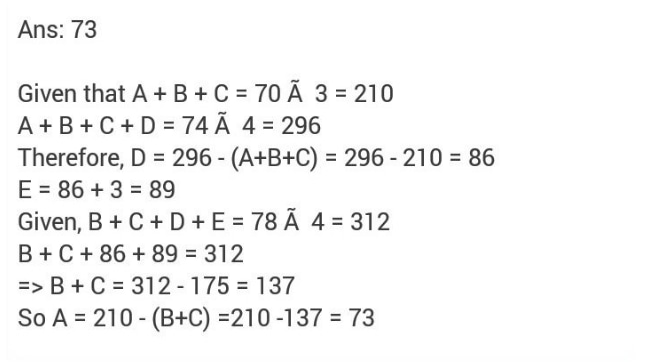
Total marks of A, B and C = 70 × 3 = 210.
Total marks of A, B, C and D = 74 × 4 = 296, so D's marks = 296 − 210 = 86.
E's marks = D's marks + 3 = 86 + 3 = 89.
Total marks of B, C, D and E = 78 × 4 = 312.
So the combined marks of B and C = 312 − (D + E) = 312 − (86 + 89) = 312 − 175 = 137.
A's marks = Total of (A, B, C) − (B + C) = 210 − 137 = 73.
Cross-check: adding D (86) and E (89) back to the derived B + C (137) gives 312, and 312 ÷ 4 = 78 — exactly the stated average of B, C, D and E — confirming A = 73 is consistent.