x, y, z are positive integers. If x(y + z) = 49, y(z + x) = 40 and z(x + y) =…
2026
x, y, z are positive integers. If x(y + z) = 49, y(z + x) = 40 and z(x + y) = 33, what is the value of x + y + z?
- A.
20
- B.
18
- C.
16
- D.
14
Attempted by 2 students.
Show answer & explanation
Correct answer: D
Concept: When a symmetric total like s = x + y + z appears inside factor-style equations (each variable multiplied by the sum of the other two), rewrite each bracket as (s − that variable). This converts x(y+z) = 49 into x(s − x) = 49, and similarly for the other two equations — turning the 3-variable system into three s-dependent relations that can be pinned down using integer factor analysis, since x, y, z are restricted to positive integers.
Application:
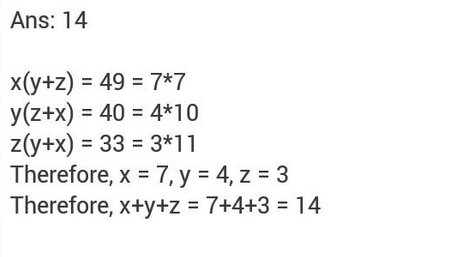
Let s = x + y + z. Since x, y, z are positive integers, x must be a factor of 49 = 1 × 49 = 7 × 7, so x ∈ {1, 7, 49}. The branch x = 49 needs y + z = 1, which is impossible since two positive integers sum to at least 2 — so only x = 1 and x = 7 remain to test; trying x = 7 gives y + z = 49 / 7 = 7.
Substitute y + z = 7 into y(z + x) = 40: z = 7 − y, so y((7 − y) + 7) = y(14 − y) = 40, which gives y2 − 14y + 40 = 0, i.e. (y − 4)(y − 10) = 0, so y = 4 or y = 10.
Since y + z = 7 with z a positive integer, y must be less than 7 — so y = 10 is rejected, leaving y = 4 and z = 7 − 4 = 3.
Check the third equation: z(x + y) = 3 × (7 + 4) = 3 × 11 = 33, which matches — confirming x = 7, y = 4, z = 3 satisfies all three original equations.
Therefore x + y + z = 7 + 4 + 3 = 14.
Cross-check: the remaining factor case is x = 1, giving y + z = 49; substituting into y(z + x) = 40 gives y(50 − y) = 40, i.e. y2 − 50y + 40 = 0, whose discriminant (2500 − 160 = 2340) is not a perfect square — so no integer solution exists on this branch either, confirming x = 7, y = 4, z = 3 (and hence x + y + z = 14) is the unique positive-integer solution.