Apples can be packed in sets of 10 apples in a box of type A or 25 apples in a…
2025
Apples can be packed in sets of 10 apples in a box of type A or 25 apples in a box of type B. If 1200 apples are to be packed using type A and type B boxes, how many different combinations of the two box types are possible?
- A.
25
- B.
21
- C.
26
- D.
24
Attempted by 6 students.
Show answer & explanation
Correct answer: A
A linear equation of the form px + qy = N has a family of non-negative integer solutions that can be counted by reducing it using the GCD of p and q, isolating one variable as a function of a parameter, and finding how many parameter values keep both variables non-negative — the valid values then form an arithmetic progression (AP), whose term count is (last minus first) divided by common difference, plus 1.
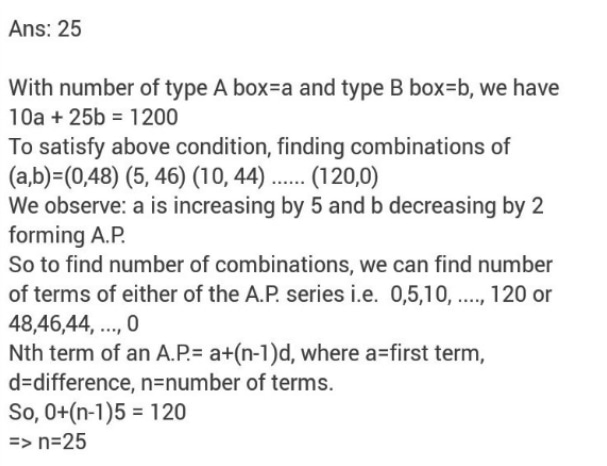
Let a = number of type A boxes (10 apples each) and b = number of type B boxes (25 apples each); then 10a + 25b = 1200.
Divide throughout by 5 (the GCD of 10, 25 and 1200): 2a + 5b = 240.
For a to be a whole number, 5b must be even, so b itself must be even; write b = 2m for m = 0, 1, 2, ...
Substituting gives 2a = 240 − 10m, so a = 120 − 5m.
Requiring a ≥ 0 gives m ≤ 24, and b ≥ 0 gives m ≥ 0, so m can take any integer value from 0 to 24.
The number of valid combinations equals the number of integers in this range: (24 − 0) ÷ 1 + 1 = 25.
Checking the two extremes confirms the range: m = 0 gives (a, b) = (120, 0), and 10(120) + 25(0) = 1200, which checks out; m = 24 gives (a, b) = (0, 48), and 25(48) = 1200, which also checks out. Both boundary combinations satisfy the equation, so all 25 intermediate values of m are valid too.
So exactly 25 different combinations of type A and type B boxes can pack the 1200 apples.