Consider the cube shown below with its 8 corners labelled a, b, c, d, e, f, g,…
2026
Consider the cube shown below with its 8 corners labelled a, b, c, d, e, f, g, and h. The figure is representative. All corners are to be colored such that any two corners that are connected by an edge must be of different colors. The minimum number of colors required to achieve this is ________
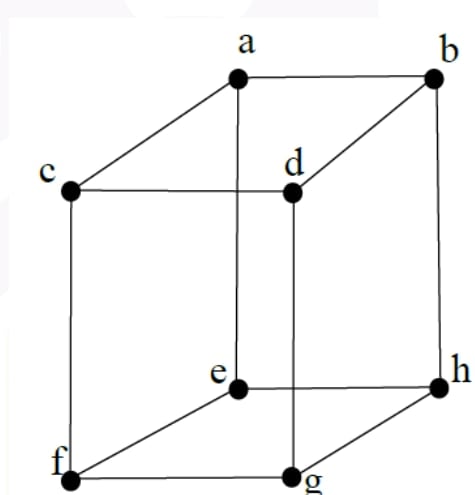
Answer: D. 2 — The problem asks for the chromatic number of the cube graph, whose vertices are the 8 corners and whose edges are the 12 cube edges. A graph can be colored…
- A.
8
- B.
4
- C.
3
- D.
2
Attempted by 22 students.
Show answer & explanation
Correct answer: D
The problem asks for the chromatic number of the cube graph, whose vertices are the 8 corners and whose edges are the 12 cube edges. A graph can be colored with two colors if and only if it is bipartite, i.e., it contains no odd cycle. The cube graph has only 4-cycles (its faces) and 6-cycles (around the body); it has no triangle or any odd cycle, so it is bipartite. Concretely, label the corners by 3-bit coordinates and split them by parity: set X = {a, d, f, h} and set Y = {b, c, e, g}. Every edge joins one vertex of X to one of Y (e.g., a–b, a–c, a–e, b–d, b–h, c–d, c–f, d–g, d–b, e–f, e–h, f–g, g–h, h–e all cross the partition). Coloring all of X one color and all of Y another color satisfies the rule. Since at least one edge exists, one color is impossible, so the minimum is 2.