Three positions of a cube are shown below. Which number will be opposite to…
2017
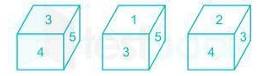
Three positions of a cube are shown below. Which number will be opposite to the face containing 4?
Answer: B. 1 — ConceptOn a cube every face has exactly one opposite face and exactly four adjacent faces, and opposite faces can never be visible together in a single view.…
- A.
2
- B.
1
- C.
5
- D.
6
Attempted by 14 students.
Show answer & explanation
Correct answer: B
Concept
On a cube every face has exactly one opposite face and exactly four adjacent faces, and opposite faces can never be visible together in a single view. So any two faces that appear together in one position are ADJACENT, not opposite. Two tools follow from this: (i) the opposite of a target face must be a number that never shares a view with it; and (ii) once a face is seen next to four different faces, the single remaining face must be its opposite.
Application
Read the three positions as Top / Front / Right faces:
Position | Top | Front | Right |
|---|---|---|---|
First | 3 | 4 | 5 |
Second | 1 | 3 | 5 |
Third | 2 | 4 | 3 |
Collect the faces seen sharing a view with 4:
First position: 4 appears with 3 and 5.
Third position: 4 appears with 2 and 3.
So 4 is adjacent to 2, 3 and 5. Removing 4 and these three neighbours from {1, 2, 3, 4, 5, 6} leaves two faces that never share a view with 4 — namely 1 and 6 — so the opposite of 4 is one of these two; the views of 4 alone cannot yet decide which.
Resolve the tie using 3. Across the positions 3 is seen with 4 and 5 (first), with 1 and 5 (second) and with 2 (third), so 3 is adjacent to four distinct faces {1, 2, 4, 5}. A face has only four neighbours, so the one face never beside 3 — which is 6 — must be opposite 3. With 6 now fixed as the opposite of 3, it is no longer available to sit opposite 4, leaving 1 as the only possibility.
So the face opposite 4 is 1.
Cross-check
Complete all three pairs: 3 is opposite 6 (just shown) and 4 is opposite 1, which leaves 2 and 5 to pair with each other, so 5 is opposite 2. The three opposite pairs 4–1, 3–6 and 5–2 use each of 1–6 exactly once and contradict none of the given views, a fully consistent assignment that confirms 1 sits opposite 4.