It is given that AB and AC are the equal sides of an isosceles ΔABC, in which…
2013
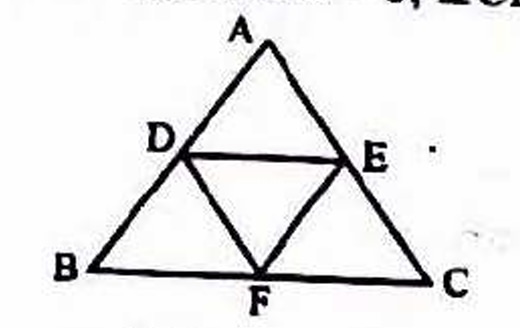
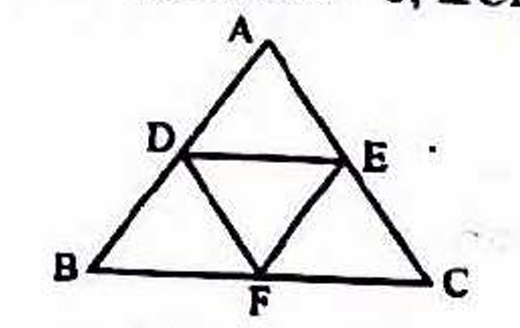
It is given that AB and AC are the equal sides of an isosceles ΔABC, in which an equilateral ΔDEF is inscribed. If ∠BFD = a, ∠ADE = b, ∠CEF = c, then
- A.
a = (b + c) / 2
- B.
b = (a + c) / 2
- C.
c = (a + b) / 2
- D.
c = 2(a + b)
Show answer & explanation
Correct answer: A
Concept
The three interior angles of any triangle sum to 180°, and angles lying along a straight line also sum to 180°. In an isosceles triangle the base angles (opposite the two equal sides) are equal, and every interior angle of an equilateral triangle equals 60°.
Step-by-step application
Since AB = AC in ΔABC, the base angles are equal: ∠ABC = ∠ACB. Call this common base angle β. Since ΔDEF is equilateral, every angle of ΔDEF equals 60°.
Points A, D, B are collinear because D lies on side AB, so the angles at D along that line satisfy ∠ADE + ∠EDF + ∠FDB = 180°. Substituting ∠ADE = b and ∠EDF = 60° gives ∠FDB = 120° − b.
Points B, F, C are collinear because F lies on side BC, so the angles at F along that line satisfy ∠BFD + ∠DFE + ∠EFC = 180°. Substituting ∠BFD = a and ∠DFE = 60° gives ∠EFC = 120° − a.
In ΔBDF, the interior angles sum to 180°: ∠DBF + ∠BFD + ∠FDB = 180°. Substituting β, a and (120° − b) gives β = 60° + b − a.
In ΔCEF, the interior angles sum to 180°: ∠ECF + ∠CEF + ∠EFC = 180°. Substituting β, c and (120° − a) gives β = 60° + a − c.
Both expressions equal the same base angle β, so 60° + b − a = 60° + a − c. Simplifying gives b + c = 2a, i.e. a = (b + c) / 2.
Cross-check
Taking b = 50° and c = 30° as a numeric check, the relation gives a = (50° + 30°) / 2 = 40°. Then β = 60° + b − a = 70° from the B side, and β = 60° + a − c = 70° from the C side — the two independently computed values of β agree, confirming the relation.
So the relationship connecting the three marked angles is a = (b + c) / 2.