The sequence of folding a piece of paper and the manner in which the folded…
2023
The sequence of folding a piece of paper and the manner in which the folded paper has been cut is shown below. Choose the figure that would most closely resemble the unfolded form of the paper.
Attempted by 6 students.
Show answer & explanation
Concept
Unfolding a cut sheet is the exact reverse of folding it. Undoing a fold does not simply repeat what is on the paper — it reflects everything already on the sheet across that fold’s crease line. Every independent fold also doubles the number of layers, so n folds stack 2n layers, and a single cut through the whole stack opens out into 2n copies of the cut shape, paired as mirror images about each crease that was used.
Application
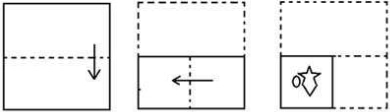
The sequence begins with a square sheet carrying a horizontal crease across its middle and a downward arrow: the upper half is folded down onto the lower half, leaving a half-height rectangle two layers thick.
That rectangle then carries a vertical crease down its middle and a leftward arrow: its right half is folded onto its left half, leaving a small square that occupies the lower-left quadrant of the original sheet and is four layers thick.
The cut is made in that four-layer square — an oval placed to the left of a star whose long lobe points downward. Because the blade passes through all four layers, the opened sheet carries one copy of the oval-and-star motif in each quadrant.
Undo the vertical fold first. Reflecting the lower-left motif across the vertical centre line carries the oval across to the right of the star, while the long lobe still points downward; that is the lower-right motif.
Now undo the horizontal fold. Reflecting the whole lower half across the horizontal centre line inverts each star, so the upper-left motif has the oval to the left of a star whose long lobe points upward, and the upper-right motif has the oval to the right of a star whose long lobe points upward.
Cross-check
The opened sheet must be symmetric about both centre lines at the same time. A mirror in the vertical crease swaps the oval from one side of the star to the other; a mirror in the horizontal crease flips the star’s long lobe from downward to upward. Applying both reflections gives exactly this sheet:
Quadrant | Oval position | Star’s long lobe |
|---|---|---|
Upper-left | to the left of the star | points up |
Upper-right | to the right of the star | points up |
Lower-left | to the left of the star | points down |
Lower-right | to the right of the star | points down |
A sheet whose upper motifs repeat the lower ones without inverting the star has recorded the vertical crease only and has lost the horizontal fold.
A sheet whose right-hand motifs repeat the left-hand ones without carrying the oval across the star has recorded the horizontal crease only and has lost the vertical fold.
A sheet in which a reflection is applied to some quadrants but not to others corresponds to no consistent pair of folds at all.