Select the correct mirror figure of the given figure when the mirror is placed…
2024
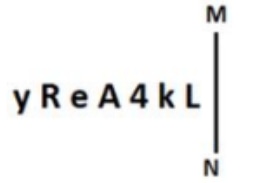
Select the correct mirror figure of the given figure when the mirror is placed at MN as shown below.
Attempted by 18 students.
Show answer & explanation
Concept: A plane mirror held along a vertical line reflects by lateral inversion: left and right are interchanged, while top and bottom are left untouched. For a row of characters this acts in two ways at once. The reading order of the row is reversed, so the character standing nearest the mirror appears first in the reflection and the character farthest from it appears last; and every individual character is additionally flipped about a vertical axis, so its own left side becomes its right side.
The one thing a vertical mirror can never do is turn a character upside down. A top-to-bottom flip, in which an apex points downward or a descender rises above the letter body, is the signature of a water image, not of a mirror image.
Application: The given row is y R e A 4 k L, and the mirror MN stands vertically at its right-hand end.
Reverse the reading order about the mirror: the L closest to MN comes first in the reflection and the y farthest from it comes last, giving the sequence L k 4 A e R y.
Flip the L about a vertical axis: its upright stroke moves to the right and its foot points to the left.
Flip the k: its stem moves to the right and both arms open to the left.
Flip the 4: its upright stroke moves to the left and the triangular counter opens to the right.
The A is symmetric about a vertical axis, so it is unchanged and its apex still points up.
Flip the e: its opening turns to face left.
Flip the R: its bowl and leg move to the left of the upright stem.
Flip the y: the fork stays on top and the tail still descends below the fork, but the tail now hooks to the right.
The reflection is therefore the sequence L k 4 A e R y with all seven of those glyphs laterally inverted.
Cross-check: Reflect that answer row back about a vertical axis and it reads y R e A 4 k L once more, which is the original figure. The same test separates the two families of near-miss rows:
Near-miss family | What such a row shows | Why a vertical mirror rules it out |
|---|---|---|
A glyph keeps its original left-right sense | an L whose foot still points right, a 4 whose upright stroke is still on the right, or an R whose bowl still sits to the right of its stem | lateral inversion swaps the left and right of every glyph, so no glyph may keep its original sense |
A glyph is turned upside down | an A resting on its apex, or a y whose tail rises above the fork instead of descending below it | a top-to-bottom flip is the signature of a water image; a vertical mirror leaves top and bottom untouched |
Result: The mirror figure is the row L k 4 A e R y with all seven glyphs laterally inverted: the L has its foot pointing left, the k has its arms opening left, the 4 has its upright stroke on the left, the A keeps its apex up, the e has its opening facing left, the R has its bowl and leg to the left of the stem, and the y keeps its fork on top with the tail descending below and hooking right.