What is a PLA?
2024
What is a PLA?
Answer: B. Programmable Logic Array — A PLA stands for Programmable Logic Array. It is a type of Programmable Logic Device (PLD) used to implement custom combinational logic circuits in digital…
- A.
Programmable Logic Application
- B.
Programmable Logic Array
- C.
Programmable Logic Architecture
- D.
More than one of the above
- E.
None of the above
Attempted by 467 students.
Show answer & explanation
Correct answer: B
A PLA stands for Programmable Logic Array. It is a type of Programmable Logic Device (PLD) used to implement custom combinational logic circuits in digital electronics.
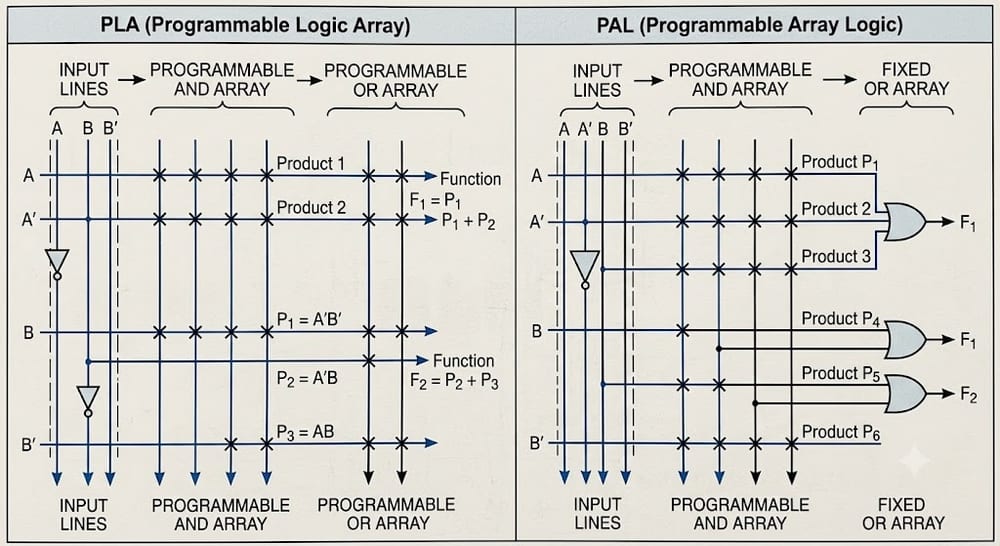
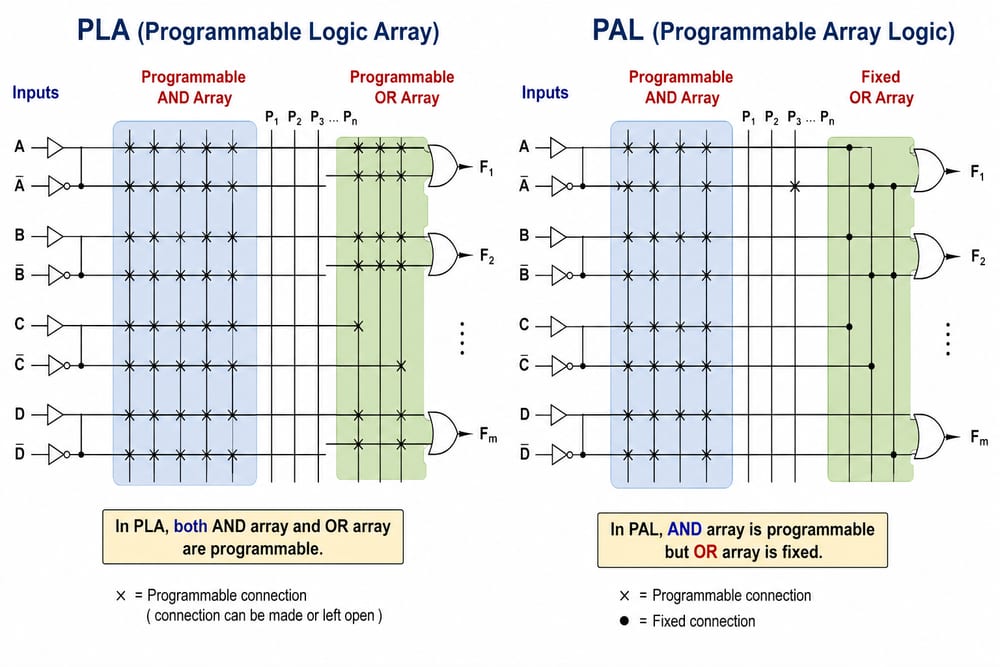
A PLA consists of two main functional matrices: a programmable AND gate array followed by a programmable OR gate array.
1. The Core Architecture
To understand a PLA, it helps to understand how it processes logic. It directly implements functions in the Sum-of-Products (SOP) form:
Programmable AND Array: The input variables (and their inverted complements via NOT gates) are fed into a matrix of AND gates. You can choose which inputs connect to which AND gates to create custom product terms.
Programmable OR Array: The outputs of these AND gates (the product terms) are then fed into a matrix of OR gates. You can choose which product terms connect to which OR gates to produce the final sum outputs.
2. PLA vs. PAL vs. ROM (The Crucial Difference)
PLA is often confused with PAL (Programmable Array Logic) and ROM (Read-Only Memory). The easiest way to distinguish them is by looking at which internal arrays can be programmed:
Device Type | AND Array | OR Array | Flexibility |
ROM | Fixed (Pre-decoded) | Programmable | Low |
PAL | Programmable | Fixed | Medium |
PLA | Programmable | Programmable | Highest |
Because both arrays are programmable in a PLA, it is highly flexible. It allows different output functions to share the exact same product terms, which saves a lot of physical space on a chip.
3. Example of How a PLA Implements an Equation
Imagine you need to implement two logic equations using a PLA:
F1 = AB + (AC)'
F2 = AB + BC
Step 1 (AND Array): You program the AND gates to generate three distinct product terms: P1 = AB, P2 = A.C' , and P3 = BC.
Step 2 (OR Array): * You program the first OR gate (F1) to connect to P1 and P2.
You program the second OR gate (F2) to connect to P1 and P3.
Notice how the term AB is shared between both outputs. This capability is what makes PLAs highly efficient.
4. Key Advantages and Disadvantages
Advantages:
Highly Efficient: Multiple outputs can share the same product terms, reducing the total gate count.
Flexible: Any Boolean function in SOP form can be mapped directly onto it.
Disadvantages:
Slower Speed: Having two programmable layers adds internal propagation delay (more resistance/capacitance at the fuse links), making them slower than PALs.
Complex and Expensive: Manufacturing a device with two fully programmable arrays is more complex than making one with a fixed array.
Summary for Exams
A PLA is a digital IC that contains a Programmable AND array and a Programmable OR array, primarily utilized to implement complex, cost-effective, and compact multi-output combinational circuits.