If a mirror is placed on the line AB, then which of the answer figures is the…
2021
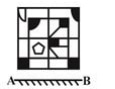
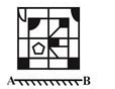
If a mirror is placed on the line AB, then which of the answer figures is the right image of the given figure?
Attempted by 154 students.
Show answer & explanation
When a mirror is kept along a horizontal line such as AB drawn below a figure, every point of the figure is reflected straight across that line. The result is a vertical (up-down) flip of the whole figure: whatever sits at the top ends up at the bottom, and whatever sits at the bottom ends up at the top, while the left-right arrangement never changes. A plain square or block that is itself symmetric about a horizontal line through its centre looks the same after this flip. Any other mark -- a curved quarter-disc, a wedge, an outline, or a pentagon -- is not symmetric that way, so it still turns upside-down as part of the flip even though it stays just as solid or just as much an outline as before: a shape with a single point at the top and a flat base at the bottom (such as a point-up pentagon) must come out with a flat top and a single point at the bottom, not unchanged.
Both bottom corners of the given figure are plain solid black squares. The top corners carry different marks instead: the top-left corner has a thin, unfilled hook-shaped outline, and the top-right corner has a solid, curved quarter-disc. After the flip, the two plain squares move to the top corners (unchanged in appearance, since a square is symmetric about a horizontal line through its centre), the hook outline moves to the bottom-left corner turned upside-down, and the quarter-disc moves to the bottom-right corner, its curve also turned upside-down.
Inside the figure's inner square, the upper-left cell holds a solid black quarter-disc anchored at its own top-left corner, and the lower-left cell holds an unfilled pentagon outline that points upward (single point at top, flat base at bottom). After the flip these two cells swap, and each mark inverts: the pentagon outline moves up into the upper-left inner cell but now points downward (flat top, single point at the bottom), and the quarter-disc moves down into the lower-left inner cell, now anchored at that cell's bottom-left corner.
On the right side of the inner square, the upper cell carries a black wedge with a diagonal line running to the centre, and the lower cell carries a black rectangle-and-notch block against the centre with its own diagonal line. After the flip, the rectangle-and-notch block moves up next to the centre divider and the wedge moves down, so the diagonal now bends the other way inside that column.
The figure whose bottom-left corner is filled solid black instead of showing an open hook has not inverted that mark correctly -- a solid fill cannot represent the flipped outline shape, so that figure is ruled out.
The figure whose upper-left pentagon still points upward, the same way as in the source figure, has left that mark unflipped -- a genuine reflection must turn it downward (flat top, point at the bottom), so that figure is ruled out even though its corners look right.
The figure whose pentagon and diagonal pattern sit on the opposite sides from the original (pentagon on the right, diagonal pattern on the left) has been mirrored left-to-right instead of flipped top-to-bottom, so that figure shows the wrong kind of reflection entirely.
Only the figure that keeps both top corners solid black, places the hook outline (correctly turned upside-down) at the bottom-left, places the quarter-disc curve at the bottom-right, shows the upper-left pentagon flipped to point downward, places the quarter-disc in the lower-left inner cell, and shows the rectangle-and-notch block swapped with the wedge on the right, satisfies every one of these checks.
That figure -- the one matching every one of these checks -- is the correct reflection of the given figure across line AB.