For the two frequency distributions given in the following table, the mean…
2019
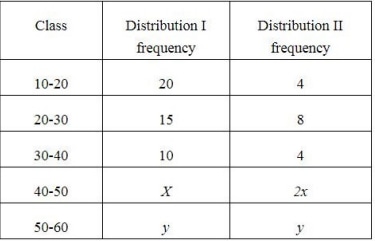
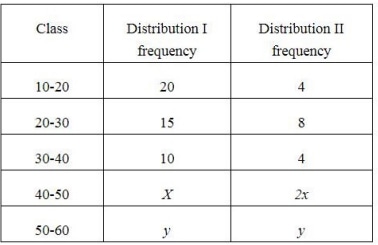
For the two frequency distributions given in the following table, the mean calculated from the first was 25.4 and that from the second was 32.5. Find the values of x and y:
Answer: B. x = 3, y = 2 — Step 1 — Class midpoints: 15, 25, 35, 45, 55 Step 2 — Set up the mean formula for Distribution I: Total frequency = 20 + 15 + 10 + X + y = 45 + X + y. Sum of…
- A.
x = 2, y = 3
- B.
x = 3, y = 2
- C.
x = 5, y = 2
- D.
x = 3, y = 4
Attempted by 62 students.
Show answer & explanation
Correct answer: B
Step 1 — Class midpoints: 15, 25, 35, 45, 55
Step 2 — Set up the mean formula for Distribution I:
Total frequency = 20 + 15 + 10 + X + y = 45 + X + y.
Sum of f·midpoint = 20·15 + 15·25 + 10·35 + X·45 + y·55 = 1025 + 45X + 55y.
Mean = (1025 + 45X + 55y) / (45 + X + y) = 25.4.
Multiply out and simplify: (1025 + 45X + 55y) = 25.4(45 + X + y) ⇒ -118 + 19.6X + 29.6y = 0.
Clear decimals (×5) and simplify: 98X + 148y = 590 ⇒ divide by 2 ⇒ 49X + 74y = 295.
Step 3 — Set up the mean formula for Distribution II:
Total frequency = 4 + 8 + 4 + 2X + y = 16 + 2X + y.
Sum of f·midpoint = 4·15 + 8·25 + 4·35 + 2X·45 + y·55 = 400 + 90X + 55y.
Mean = (400 + 90X + 55y) / (16 + 2X + y) = 32.5.
Multiply out and simplify: (400 + 90X + 55y) = 32.5(16 + 2X + y) ⇒ -120 + 25X + 22.5y = 0.
Clear decimals (×2) and simplify: 50X + 45y = 240 ⇒ divide by 5 ⇒ 10X + 9y = 48.
Step 4 — Solve the two linear equations:
From 10X + 9y = 48, express X = (48 − 9y)/10. For X to be an integer, 48 − 9y must be divisible by 10, which gives y ≡ 2 (mod 10).
Try the smallest positive feasible y = 2 → X = (48 − 18)/10 = 30/10 = 3.
Check in the first equation: 49·3 + 74·2 = 147 + 148 = 295, which satisfies 49X + 74y = 295.
Answer: x = 3, y = 2.