Then the value of c + d is:
2013
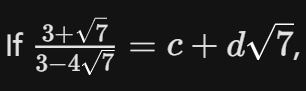
Then the value of c + d is:
- A.
52/103
- B.
-52/103
- C.
51/103
- D.
-51/103
Attempted by 1 students.
Show answer & explanation
Correct answer: B
When a fraction's denominator contains a surd (an irrational square-root term), it is simplified by rationalizing the denominator — multiplying the numerator and denominator by the denominator's conjugate. For a binomial surd of the form p − q√n, the conjugate is p + q√n, and the identity (p − q√n)(p + q√n) = p² − q²n removes the square root from the denominator entirely.
Applying this to (3 + √7) / (3 − 4√7):
Multiply the numerator and denominator by the conjugate of the denominator, 3 + 4√7.
Simplify the denominator: (3 − 4√7)(3 + 4√7) = 3² − (4√7)² = 9 − 16×7 = 9 − 112 = −103.
Expand the numerator: (3 + √7)(3 + 4√7) = 3×3 + 3×4√7 + √7×3 + √7×4√7 = 9 + 12√7 + 3√7 + 28 = 37 + 15√7.
So the expression becomes (37 + 15√7) / (−103) = −37/103 − (15/103)√7.
Matching this to the form c + d√7 gives c = −37/103 and d = −15/103, so c + d = (−37 − 15)/103 = −52/103.
Cross-check numerically with √7 ≈ 2.6458: the original expression (3 + 2.6458)/(3 − 4×2.6458) ≈ 5.6458/(−7.583) ≈ −0.745, and c + d√7 = −0.359 + (−0.146 × 2.6458) ≈ −0.359 − 0.386 ≈ −0.745 — the two match, confirming the values of c and d.
Hence c + d = −52/103.