In the adjoining figure, PS bisects ∠QPR, PT ⟂ QR, and ∠Q > ∠R. Then ∠TPS…
2022
In the adjoining figure, PS bisects ∠QPR, PT ⟂ QR, and ∠Q > ∠R. Then ∠TPS equals:
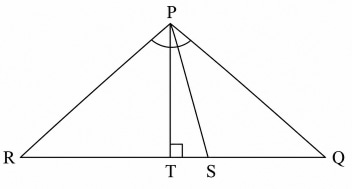
Answer: B. 1/2(∠Q − ∠R) — CONCEPTIn any triangle, the interior angles sum to 180°. An angle bisector halves its vertex angle, while an altitude creates a right triangle; these facts…
- A.
∠Q − ∠R
- B.
1/2(∠Q − ∠R)
- C.
∠Q + ∠R
- D.
1/2(∠Q + ∠R)
Attempted by 36 students.
Show answer & explanation
Correct answer: B
CONCEPT
In any triangle, the interior angles sum to 180°. An angle bisector halves its vertex angle, while an altitude creates a right triangle; these facts let us express both rays from the same side and subtract their directions.
If the two base angles are unequal, the angle between the altitude and the vertex-angle bisector equals half the absolute difference of the base angles.
APPLICATION
Let ∠Q = Q and ∠R = R. By the triangle angle-sum property, ∠QPR = 180° − (Q + R).
Because PS bisects ∠QPR, ∠QPS = (1/2)∠QPR = 90° − (1/2)(Q + R).
Since PT ⟂ QR, triangle PQT is right-angled at T. Therefore ∠QPT = 90° − Q.
The condition Q > R gives ∠QPS > ∠QPT, so PT lies between PQ and PS; hence ∠TPS = ∠QPS − ∠QPT.
Substituting gives ∠TPS = [90° − (1/2)(Q + R)] − (90° − Q) = (1/2)Q − (1/2)R = (1/2)(Q − R).
CROSS-CHECK
Take Q = 70° and R = 50°. Then ∠QPR = 60°, so ∠QPS = 30°, while ∠QPT = 20°; their separation is 10°.
The formula gives (1/2)(70° − 50°) = 10°, matching the direct angle calculation.
RESULT
Therefore, ∠TPS = (1/2)(∠Q − ∠R).