In the given figure PAQ is the tangent of the circle at point A and ABCD is a…
2018
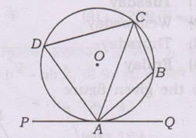
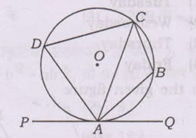
In the given figure PAQ is the tangent of the circle at point A and ABCD is a cyclic quadrilateral. If ∠CAQ = 70°, then ∠ABC is:
- A.
70°
- B.
80°
- C.
110°
- D.
90°
Attempted by 1 students.
Show answer & explanation
Correct answer: C
When a tangent touches a circle at a point and a chord is drawn from that same point, the tangent-chord angle equals the inscribed angle that the same chord subtends in the alternate segment. Also, in any cyclic quadrilateral, each pair of opposite angles adds up to 180°.
The tangent ray AQ and chord AC meet at A on the side of the circle containing arc ABC, so ∠CAQ = 70° is the tangent-chord angle for chord AC on that side.
By the tangent-chord angle theorem, this angle equals the inscribed angle that chord AC subtends from the opposite arc, i.e. ∠ADC = 70°.
ABCD is a cyclic quadrilateral, so ∠ABC and ∠ADC are opposite angles and satisfy ∠ABC + ∠ADC = 180°.
Substituting ∠ADC = 70°: ∠ABC = 180° − 70° = 110°.
As an independent cross-check using arcs:
Writing the four arcs AB, BC, CD, DA as a, b, c, d (a + b + c + d = 360°): the tangent-chord angle ∠CAQ = (a+b)/2 = 70°, so a + b = 140°.
∠ABC is the inscribed angle subtending arc ADC = c + d = 360° − 140° = 220°, so ∠ABC = 220°/2 = 110°, confirming the result.
Hence ∠ABC = 110°.