An umbrella is made by stitching 10 congruent triangular pieces of cloth in…
2019
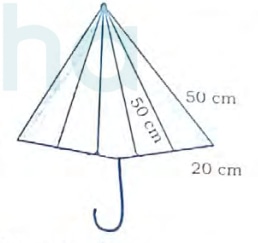
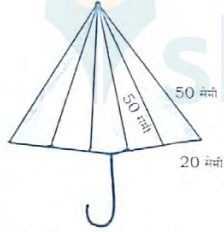
An umbrella is made by stitching 10 congruent triangular pieces of cloth in two different colours, with 5 pieces of each colour. Each triangular piece has side lengths 20 cm, 50 cm, and 50 cm. How much cloth of each colour is required for the umbrella?
- A.
1000√6 cm2
- B.
10000√6 cm2
- C.
100√6 cm2
- D.
5000√6 cm2
Attempted by 1 students.
Show answer & explanation
Correct answer: A
Concept
For a triangle with side lengths a, b, and c, Heron’s formula gives its area as √[s(s − a)(s − b)(s − c)], where s = (a + b + c)/2 is the semi-perimeter.
When congruent pieces are divided equally between colours, the cloth required for one colour equals the area of one piece multiplied by the number of pieces of that colour.
Application
For one triangular piece, the semi-perimeter is s = (20 + 50 + 50)/2 = 60 cm.
The three differences are s − 20 = 40 cm, s − 50 = 10 cm, and s − 50 = 10 cm.
By Heron’s formula, the area of one piece is √(60 × 40 × 10 × 10) = √240000 = 200√6 cm2.
There are 10 pieces in two colours, with 5 congruent pieces of each colour.
Therefore, cloth required for one colour is 5 × 200√6 = 1000√6 cm2.
Cross-check
The triangle is isosceles. Its height is √(502 − 102) = 20√6 cm, so its area is (1/2) × 20 × 20√6 = 200√6 cm2, confirming the Heron’s-formula result.
Hence, 1000√6 cm2 of cloth of each colour is required.